

Animals DNA strand 3D isometric Free icon download
Download all to grab every PNG variant.
```html
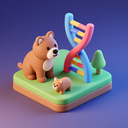
This meticulously crafted 3D isometric icon presents a visually striking fusion of biological concepts and artistic design, centering around two powerful symbolic elements: animals and the DNA strand. The icon operates at the intersection of science, nature, and modern graphic design principles, creating a compelling visual narrative that speaks to genetic diversity, evolutionary biology, and the interconnectedness of life forms across species.
At its core, this 3D isometric icon employs a dynamic perspective that simulates depth and spatial relationships through precise geometric angles. The isometric projection ensures that all three dimensions—height, width, and depth—are represented at equal scales with 30-degree angles from the horizontal plane. This creates an engaging sense of realism while maintaining the clean, structured aesthetic characteristic of isometric art. The entire composition appears as if floating in space or sitting on a transparent grid plane, giving it a futuristic yet organic quality.
The central visual motif revolves around a stylized DNA double helix, rendered in vibrant, translucent blue and white hues that evoke the molecular elegance of genetic material. This DNA strand is not merely decorative; it serves as the foundational element connecting all other components of the icon. The helix spirals upward from the lower left to upper right corner of the frame, creating a sense of upward evolution and progress. Each nucleotide base pair is subtly differentiated using color variations—adenine (yellow), thymine (red), cytosine (blue), and guanine (green)—not only enhancing visual interest but also symbolizing genetic coding diversity.
Interwoven within the DNA helix are various representations of animals, each rendered in a consistent 3D isometric style that harmonizes with the overall aesthetic. These animal elements are not randomly placed but strategically positioned to reflect evolutionary relationships and biological continuity. For example, at the base of the DNA strand lies a small, intricate representation of a single-celled organism—a primitive life form—symbolizing the origin of all life. As the helix ascends, more complex creatures emerge from its coils: first reptilian forms with scaly textures and sharp features; then mammals with detailed fur patterns and expressive eyes; followed by avian silhouettes with delicate wing structures.
Each animal is rendered in a simplified yet anatomically accurate 3D isometric style. The creatures are constructed using clean, geometric lines and solid fills that suggest volume without overwhelming detail. This approach ensures clarity at small sizes while preserving the recognizability of species such as a lion (symbolizing strength and dominance), a dolphin (representing intelligence and aquatic life), an eagle (emblematic of freedom and vision), and a butterfly (a powerful metaphor for transformation, metamorphosis, and biodiversity). The animals are not merely attached to the DNA strand; they seem to emerge from it, visually reinforcing the concept that all animal life shares a common genetic heritage.
Textures are carefully applied to enhance realism without compromising the isometric integrity. The DNA strand features a subtle gradient and slight translucency, giving it a luminous, almost crystalline quality. Animal forms incorporate surface details such as fur stippling, feather layering, or scale patterns—all rendered through fine line work that maintains the 3D effect. Light sources are simulated from the top left to cast soft shadows beneath each element, further amplifying depth and spatial realism.
Color choices are deliberate and meaningful. The DNA helix uses cool tones—blue, white, silver—evoking science, technology, and molecular precision. In contrast, the animals employ warmer hues: golden tawny browns for lions, deep ocean blues for dolphins, rich earthy greens for insects like the butterfly. These warm colors represent life force and biological diversity. The harmonious blend of cool and warm palettes creates visual balance while symbolizing the fusion of genetic code (science) with living organisms (nature).
Functionally, this icon is versatile across digital platforms—from scientific applications and genetic research interfaces to educational tools for biology students or environmental advocacy campaigns. Its combination of abstract molecular symbolism with concrete animal representations makes it ideal for illustrating topics such as biodiversity, evolution, genome editing (CRISPR), conservation efforts, or the ethical implications of genetic engineering.
In summary, this 3D isometric icon masterfully integrates the themes of animals and DNA strand within a cohesive visual language. Through precise geometric perspective, symbolic placement of biological forms, and thoughtful use of color and texture, it transforms complex scientific ideas into an accessible, aesthetically pleasing representation. It stands as a testament to how modern design can bridge the gap between art and science—celebrating both the diversity of life on Earth and the invisible blueprint that unites all living things: DNA.
```Create your own icon with our GoGPT AI prompt:
GoGPT