

Animals Road Flat design Free icon download
Download all to grab every PNG variant.
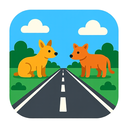
The icon in question is a meticulously crafted representation that seamlessly blends the themes of animals, road infrastructure, and flat design aesthetics into a single cohesive visual statement. At its core, this icon embodies the dynamic relationship between wildlife and human transportation systems—a theme increasingly relevant in our modern world where urban expansion intersects with natural habitats. The composition centers on two primary elements: a stylized animal figure—specifically a deer—mid-stride across a simplified road, set against a minimalist backdrop that reinforces the flat design philosophy.
From an artistic standpoint, the icon adheres strictly to flat design principles. This means no gradients, shadows, or complex textures are employed; instead, the entire image relies on bold geometric forms and solid colors. The color palette is intentionally restrained yet impactful: a soft sage green represents the natural landscape surrounding the road; a deep gray outlines and defines both the roadway and animal silhouette; while subtle highlights in white or light beige provide just enough contrast to suggest form without violating the flat aesthetic. This intentional simplicity allows for immediate recognition, even at small sizes—ideal for use in mobile applications, signage systems, or navigation tools.
The road is depicted as a clean, horizontal rectangle with sharply defined edges and slight perspective lines that subtly suggest depth while maintaining the two-dimensional nature of flat design. The road surface features dashed lane markings composed of evenly spaced rectangular segments—again rendered in crisp white—providing visual cues about traffic flow without overwhelming the composition. These elements are not merely decorative but serve a functional purpose: they reinforce the icon's meaning as a symbol for crossroads between nature and human infrastructure.
Center stage is the animal—a deer in motion, portrayed with graceful, elongated limbs and an arched back that conveys forward momentum. The deer’s silhouette is highly abstracted: its head points slightly upward, ears perked as if alert to its surroundings; its body is streamlined into a series of smooth curves and angular planes that suggest both strength and agility. Despite the minimalistic approach, the animal's posture communicates a sense of urgency or purpose—perhaps crossing a highway during migration season. The design avoids realistic anatomical detail but retains enough recognizable characteristics (such as long legs, slender neck, and antlers) to ensure instant identification.
The integration of animals within the context of road imagery is particularly significant. In many regions around the world, wildlife crossings have become essential components of transportation planning to reduce animal-vehicle collisions and preserve ecological corridors. This icon serves as a symbolic representation of such initiatives—highlighting not just the danger posed by roads to animals but also potential solutions like overpasses, underpasses, or designated crossing zones. Its presence on maps, safety alerts, or environmental awareness campaigns could signal areas where drivers should be extra cautious or where conservation measures are in place.
Flat design enhances this message by ensuring clarity and universality. Because the icon does not rely on cultural references or complex visual storytelling techniques, it transcends language barriers and can be understood globally. Whether viewed on a smartphone screen, a digital dashboard, or printed signage, the symbol remains legible due to its clean lines and high contrast between elements. The absence of ornamental details also makes it scalable—perfect for use in both low-resolution displays and high-definition formats.
Furthermore, the icon’s simplicity allows for creative adaptation. For example, different animal species (such as foxes, rabbits, or turtles) could be substituted into the same framework to represent region-specific wildlife concerns. The road structure might also vary slightly—perhaps with a bridge element added above it—to indicate a wildlife overpass. All of these variations would maintain the integrity of the flat design language while expanding its narrative potential.
In conclusion, this icon is more than just an aesthetic choice; it is a powerful visual metaphor that speaks to contemporary environmental challenges. By combining animals, road systems, and flat design into one harmonious image, it achieves both functional clarity and symbolic depth. It reminds viewers of the delicate balance between technological advancement and natural preservation—a balance that must be carefully maintained for the health of ecosystems and human safety alike. This icon stands as a testament to thoughtful design: where form meets function, nature intersects with infrastructure, and simplicity communicates complexity.
Create your own icon with our GoGPT AI prompt:
GoGPT