

Animals Road Minimal outline Free icon download
Download all to grab every PNG variant.
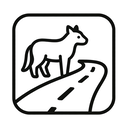
The icon in question is a masterclass in minimalist design philosophy—an elegant synthesis of three distinct thematic elements: Animals, Road, and the Minimal Outline. Each component contributes to a balanced visual narrative that transcends mere representation, inviting viewers into a symbolic dialogue between nature, movement, and human progress. This icon is not merely an image; it is a quiet statement about coexistence—between wild life and urban infrastructure, between natural instincts and the rhythm of travel.
At its core, the icon features a single animal—a deer—rendered in a minimalist outline style. The choice of the deer is deliberate. As one of nature’s most graceful creatures, the deer symbolizes alertness, gentleness, and a deep connection to wilderness environments. Its presence introduces an organic, living element into the composition. However, rather than being depicted with intricate textures or shading—common in more illustrative styles—the deer is reduced to its essential form: a flowing line that captures the essence of its silhouette without overwhelming detail. The body is elongated slightly to suggest motion; the legs are subtly tapered and spaced apart as if mid-step, giving an impression of quiet grace rather than stillness. The head is turned slightly upward, ears pricked forward—an indication of awareness or caution.
What elevates this icon beyond a simple animal illustration is the integration of a road that weaves seamlessly beneath and around the deer. The road does not dominate the composition, but it occupies a critical role in context and meaning. It is drawn as two parallel lines with gentle curves—reminiscent of a rural highway or forest trail—suggesting both continuity and direction. These lines are thin, clean, and unobtrusive, adhering perfectly to the principle of minimalism: only what is necessary remains. The road’s path gently arcs beneath the deer’s body, as if the animal is crossing over it—or perhaps pausing mid-crossing—invoking themes of transition and shared space. This subtle interaction between creature and infrastructure creates a powerful narrative: a moment frozen in time where nature meets human-made systems.
The minimal outline aesthetic is the unifying thread that binds all elements together. Every line in the icon is deliberate, purposeful, and devoid of ornamentation. There are no fills, gradients, or shadows—only black lines on a white background (or vice versa), creating stark contrast and high readability across devices and scales. The absence of color reinforces the icon’s universal appeal; it can function in any context—from digital interfaces to print materials—without losing clarity or impact. The clean geometry of the outline invites interpretation rather than imposing a fixed meaning, allowing viewers to project their own experiences: a late-night drive through forests, a conservation message, or even an artistic meditation on harmony and disruption.
From a technical standpoint, the icon's proportions are carefully calibrated. The deer is centered in the frame but not statically so; its dynamic posture draws attention toward the road below. The path of the road follows a natural S-curve, echoing both the shape of real-world rural roads and organic forms found in nature itself. This symmetry between man-made and natural lines enhances visual balance and reinforces the icon’s thematic message: that infrastructure does not have to eradicate nature—it can coexist with it. The negative space surrounding the deer and road is used as a design feature, emphasizing clarity rather than clutter.
Functionally, this icon could serve a variety of purposes. It might appear in environmental awareness campaigns promoting wildlife crossings or responsible driving. In mobile app interfaces for hiking or nature photography, it could signal an area where animals are frequently seen near roads. In urban planning tools, it may represent the need for ecologically sensitive road design. Its versatility stems from its simplicity—while rich in symbolic meaning, it remains instantly legible even at very small sizes.
In essence, this icon transcends its components to become a metaphor for modern life: the quiet tension and potential harmony between humanity’s desire to travel and our responsibility toward the natural world. The Animals symbolize instinct, vulnerability, and beauty; the Road embodies progress, connection, and movement; while the Minimal Outline style represents clarity, intentionality, and timelessness. Together, they form an image that speaks volumes without saying a word—proving that sometimes less is not only more but profoundly meaningful.
This icon stands as a testament to thoughtful design: where every line serves a purpose, every shape tells a story, and the space between elements says as much as the elements themselves.
Create your own icon with our GoGPT AI prompt:
GoGPT