

Animals Road Simplified Free icon download
Download all to grab every PNG variant.
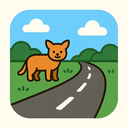
The icon in question is a masterclass in minimalist design, encapsulating the complex and often poignant theme of "Animals," "Road," and "Simplified" into a single, instantly recognizable visual symbol. At first glance, it appears deceptively simple—a few clean lines on a neutral background—but upon closer inspection reveals layers of meaning, emotion, and environmental awareness. The icon portrays an animal—likely a deer or small wildlife creature—midway across a paved road in the midst of its journey through the natural world. Despite the minimal number of visual elements, every line and shape is intentional, serving both aesthetic and symbolic purposes.
Firstly, let's examine how "Animals" are represented. The creature depicted is not rendered with anatomical precision or intricate detailing; instead, it's a stylized silhouette that captures only the essential features necessary for recognition. The animal’s body is formed from two gentle curves—a rounded back and a slightly tapered front—evoking both grace and movement. Its head is a small, elongated oval with two upward-pointing ears, suggesting alertness or curiosity as it navigates its environment. Two short, sturdy legs at the front and slightly longer ones at the back indicate motion forward, as if caught in the moment of stepping onto asphalt from grassy terrain. The eyes are represented by two tiny dots—one on each side of the head—adding a touch of life and awareness without overwhelming the minimalist aesthetic. This deliberate reduction in detail is not a compromise but a strength: it allows viewers from any cultural or linguistic background to instantly identify the subject as an animal, regardless of species, thereby universalizing its message.
The "Road" element is equally fundamental to the icon’s meaning and design. It appears as a stark, horizontal rectangle in a muted grayish-brown tone—evoking concrete or asphalt—sitting firmly across the center of the composition. This road is not textured or decorated with lane markings, speed limits, or traffic signs; it exists purely as a functional barrier and passage. Its simplicity underscores its role: not as a destination but as an obstacle, a threshold between nature and human infrastructure. The road’s unadorned appearance reinforces the idea that such crossings are common yet often overlooked in everyday life—until they become tragedies. In this icon, the road is more than just a surface; it becomes symbolic of urban expansion encroaching on natural habitats, highlighting the ongoing conflict between wildlife mobility and modern transportation systems.
Perhaps most critically, the concept of "Simplified" is not merely a stylistic choice but a philosophical one. This icon operates under the principle that clarity often surpasses complexity in visual communication. Each shape is reduced to its essential form: no shadows, gradients, or realistic textures are used. The color palette is intentionally restrained—typically limited to two or three hues such as black for the animal, gray for the road, and white or light beige for the background—ensuring that the icon remains legible at small sizes and in various contexts. This simplicity enhances its functionality in signage, mobile applications, maps, and educational materials. Moreover, by stripping away unnecessary details, the icon avoids distracting viewers from its central message: a reminder of wildlife’s vulnerability when human development meets nature.
When viewed collectively, "Animals," "Road," and "Simplified" coalesce into a powerful symbol of environmental awareness. The icon serves not only as a warning sign for drivers—particularly in rural or forested areas—but also as an invitation to reflect on our relationship with the natural world. It prompts questions: How do we accommodate wildlife? What are the consequences of ignoring their migration patterns? How can cities and road networks be designed with ecological sensitivity?
Its minimalist style ensures broad appeal across demographics, cultures, and languages. A child in Tokyo can understand this icon just as easily as a farmer in rural Kenya. Its absence of text makes it universally accessible—a true triumph of visual language. Furthermore, the simplicity enables infinite scalability: whether displayed on a smartphone screen or printed on a large roadside sign, the icon retains its clarity and impact.
In conclusion, this icon stands as an exemplary fusion of artistic minimalism and social commentary. Through its simplified yet expressive depiction of an animal crossing a road, it captures profound themes related to conservation, coexistence, and human responsibility. By distilling complex ecological issues into a few deliberate lines and shapes, the icon proves that sometimes less truly is more—especially when it comes to awakening awareness in an increasingly fragmented world.
Create your own icon with our GoGPT AI prompt:
GoGPT