

Education Graduation cap Origami – Free icon download
Download all to grab every PNG variant.
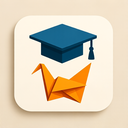
Icon Description: A Symbol of Education, Graduation Cap, and Origami
The icon in question is a richly layered and symbolically profound representation that seamlessly integrates the themes of Education, the Graduation Cap, and Origami. This intricate design transcends simple visual aesthetics to serve as a powerful metaphor for lifelong learning, cultural expression, and intellectual growth. At its core lies a fusion of tradition and innovation—an artistic synthesis that celebrates both academic achievement and the timeless artistry of paper folding. Every element within this icon is intentionally crafted to reflect the interplay between structured knowledge systems and the freeform creativity inherent in origami, creating a harmonious balance between discipline and imagination.
Central to the design is a stylized graduation cap, rendered in soft pastel colors such as lavender, gold, and sky blue. The cap sits atop a gently curved base resembling an open book or a rising academic diploma. Rather than being static or conventional, the graduation cap appears to be folded and lifted with subtle motion—suggesting not just completion of studies but also the ongoing journey of intellectual evolution. The brim of the cap is subtly shaped like a traditional origami crane’s wing, drawing direct visual connections between academic achievement and artistic craftsmanship. This fusion underscores a key philosophy: education does not end at graduation; instead, it transforms into an ever-expanding field of creative exploration.
The origami element is not merely decorative—it is foundational to the icon's meaning. The background of the design features a subtle network of folded paper forms, including a crane, a boat, and a simple square—a representation of how origami symbolizes structure born from simplicity. Each fold represents an act of thought, planning, and precision—qualities essential in any educational journey. These folds are not random; they are arranged in patterns that resemble classroom diagrams or mind maps. This interweaving of paper folds with academic structures demonstrates that learning is a process of folding complex ideas into understandable forms—a metaphor for how knowledge is constructed from basic principles through critical thinking and practice.
Within the cap itself, tiny origami elements are embedded—small folded shapes that resemble letters, equations, and diagrams. These represent specific areas of study such as mathematics, literature, science, and social sciences. The presence of these miniature symbols demonstrates that education is not monolithic but diverse—each subject contributes a unique fold to the greater whole of personal growth. Moreover, the origami elements appear to be gently suspended in mid-air, symbolizing how knowledge can be both grounded and dynamic—an idea reflective of modern pedagogical approaches that emphasize active engagement and experiential learning.
One particularly striking feature of this icon is the way the origami paper appears to "unfold" as it moves toward the center of the design. This unfolding suggests a journey from simplicity to complexity, mirroring how students begin with foundational knowledge and gradually develop deeper understanding through years of study. The transition from folded paper to open form visually represents cognitive growth—the moment when abstract ideas are realized and internalized. In this way, origami becomes a metaphor not just for the medium of paper but for the mind’s ability to transform simple concepts into intricate understandings.
The overall color palette further reinforces the educational themes. Soft gradients from warm whites to cool blues evoke a sense of calm focus and intellectual clarity. The use of light tones avoids overwhelming visual stimulus, reflecting how effective education fosters mental balance and emotional well-being. The gold accents on the graduation cap signify achievement, recognition, and the value placed on academic excellence—yet they are not dominant; instead, they act as subtle highlights that do not overshadow the delicate folds of origami.
From a cultural perspective, this icon also speaks to global values. Origami originates in Japan—a culture deeply rooted in respect for tradition and mindfulness—and its inclusion within an educational symbol honors that heritage. At the same time, the graduation cap is a universal symbol of academic success found across nations and institutions. By combining these two traditions, the icon becomes a bridge between East and West, between ancient craftsmanship and modern education systems. It suggests that learning can be both formal (represented by degrees) and deeply personal (represented by handcrafted art).
Furthermore, the icon embodies inclusivity. It does not favor one type of learner—visual, auditory, or kinesthetic—because origami is a tactile activity that engages multiple senses. Just as education today is moving toward student-centered learning models that recognize diverse learning styles, this icon celebrates the idea that knowledge can be grasped through many pathways. Whether through reading a textbook, participating in a group project, or folding paper into shapes, each method contributes to holistic development.
Another important dimension is sustainability. Origami uses only paper—a renewable resource—and its minimal waste aligns with modern educational philosophies that emphasize environmental responsibility. In an age where climate change and ecological awareness are central concerns, this icon subtly promotes the idea that education should not only advance knowledge but also cultivate a sense of stewardship for our planet.
Ultimately, this icon stands as a powerful emblem for what education can be: transformative, creative, and deeply human. It is more than just a visual representation—it is an invitation. An invitation to students to see learning not as rigid rules or exams but as an art form of folding ideas into reality. It encourages educators to teach with both rigor and imagination, blending structured curricula with open-ended exploration. And it reminds society that true education is not measured solely by diplomas, but by the ability of individuals to think critically, create beautifully, and grow through experience.
By merging the Graduation Cap with Origami, this icon redefines success in education—not as an endpoint, but as a continuous process of folding, unfolding, and reinventing oneself. It is a symbol of resilience, curiosity, and lifelong learning—an emblem that resonates with students at every stage of their educational journey.
Create your own icon with our GoGPT AI prompt:
GoGPT