

Education Light bulb Origami – Free icon download
Download all to grab every PNG variant.
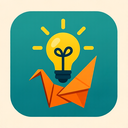
In a world where innovation drives progress and knowledge is power, the convergence of three powerful symbols—Education, Light Bulb, and Origami—creates a visually compelling and conceptually rich icon that embodies both intellectual growth and creative transformation. This intricate icon does not merely represent one idea; it synthesizes the spirit of learning with the spark of inspiration and the elegance of hands-on creation. Designed with intention and depth, this emblem serves as a beacon for educators, students, innovators, and lifelong learners who seek to expand their horizons through curiosity, creativity, and structured exploration.
The central element of this icon is a stylized light bulb that has been thoughtfully transformed into an origami crane. This fusion is not arbitrary—it reflects the fundamental connection between education and innovation. The traditional light bulb symbolizes enlightenment and discovery, often associated with the moment when a new idea suddenly clicks into place during learning or problem-solving. In classic representations, a light bulb signifies inspiration—like that flash of insight in a classroom during a difficult math problem or when students grasp how to write an effective argumentative essay. This icon takes that moment of "aha!" and gives it form through origami.
By morphing the light bulb into an origami crane, the design emphasizes transformation and adaptability—key traits in educational environments. The crane, a cultural symbol deeply rooted in Japanese traditions, represents harmony, patience, and the beauty of intricate craftsmanship. In education, this mirrors how learning is not just about memorizing facts but about folding complex ideas into meaningful understanding. Just as an origami paper model begins as a flat sheet and transforms through precise folds into a three-dimensional creature with wings and tail, so too does knowledge evolve in the mind through structured thought, repetition, reflection, and practice.
The structure of the light bulb itself is carefully designed to resemble an origami base. The central sphere of the bulb is formed from a folded square or triangle, with its inner filament represented by a delicate series of interlocking creases—like those found in traditional paper folding patterns. These creases do not just serve as visual detail; they represent cognitive pathways—each fold symbolizing a step in the learning process: observation, analysis, synthesis, evaluation. When viewed under close scrutiny, one can see how each layer builds upon the last, just as students build their understanding over time through iterative learning.
The wings of the crane are extended from the base of the light bulb and form a graceful arc that curves upward into a radiant glow. This upward motion evokes aspiration—a key component in educational journeys. Students are not merely passive recipients of knowledge; they are encouraged to rise, reach for new ideas, and expand their intellectual horizons. The glow emanating from the crane's wings is not just light—it is the energy of discovery, the warmth of curiosity that fuels classrooms and research labs alike. In this way, the icon visually communicates that education produces not only knowledge but also emotional intelligence and confidence.
Furthermore, the use of origami introduces a tactile dimension to an otherwise abstract concept. While digital learning platforms dominate modern education, this icon reminds us of the value of hands-on experiences—of building models, conducting experiments, or even engaging in creative projects like paper crafts. The act of folding paper requires focus, patience, and precision—skills that are directly transferable to academic disciplines such as science (where experiments require careful setup), math (where patterns must be identified), and even language arts (where structure and form matter). Thus, this icon promotes a holistic view of education—one that values both cognitive development and practical application.
Additionally, the light bulb within the origami crane serves as a metaphor for accessibility in learning. Just as every piece of paper used in origami can be folded into something beautiful regardless of its initial state, every student has potential to grow and succeed if given the right tools and opportunities. The icon suggests that education should not be limited by background or ability—anyone, with curiosity and effort, can fold their own light bulb into a source of inspiration. This democratizes learning; it emphasizes inclusion, adaptability, and personal agency.
From a design standpoint, the icon is balanced and harmonious. The origami crane maintains symmetry while still allowing room for dynamic movement—its wings open slightly as if ready to take flight. The light bulb’s glow appears soft yet vibrant, evoking both warmth and brightness. Color-wise, the icon might use warm tones like amber or golden yellow to represent knowledge and enlightenment, with hints of blue in the folds to suggest clarity and depth. This visual palette reinforces the idea that education is not just about intensity but also about calm focus and thoughtful reflection.
Finally, this icon transcends its literal form. It can be used in a wide range of educational settings—from school logos and teaching aids to university branding or digital learning platforms. In classrooms, it could serve as a motivational symbol displayed during group projects or innovation challenges. On apps and websites dedicated to student development, it would represent the core mission: to inspire creative thinking and lifelong curiosity.
Therefore, this icon—blending Education, Light Bulb, and Origami—is not just a design element; it is a narrative of growth. It tells the story of how learning begins with a spark (the light bulb), evolves through careful construction (origami folds), and ultimately leads to the creation of something meaningful and enduring (a crane soaring toward knowledge). It celebrates both intellectual achievement and creative expression, reminding us that education is not just about what we learn, but how we learn it—and what we become in the process.
In conclusion, this icon stands as a powerful visual metaphor for modern education: adaptive, inspiring, and deeply rooted in human creativity. Whether seen on a classroom wall or embedded in a digital learning interface, it encourages students and educators alike to embrace curiosity, practice patience with their learning journey, and believe that every idea—like every paper fold—can be shaped into something extraordinary.
Create your own icon with our GoGPT AI prompt:
GoGPT