

Fashion Moon Retro Free icon download
Download all to grab every PNG variant.
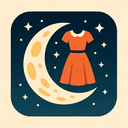
The icon in question is a masterful confluence of three distinct yet harmoniously intertwined themes: Fashion, Moon, and Retro. At first glance, it appears as a simple symbol—yet upon closer inspection, it unfolds into a rich tapestry of visual storytelling that transcends mere aesthetics. This emblem embodies the essence of 1970s counterculture while simultaneously projecting an otherworldly elegance inspired by lunar mysticism. It is both timeless and timely—a relic of the past that feels profoundly contemporary. The central motif is a stylized crescent moon, rendered in a shimmering silver gradient that mimics the reflective surface of actual lunar terrain. However, this moon is no ordinary celestial body; it has been reimagined as an elegant headpiece worn by a silhouette of a woman whose figure evokes the iconic fashion silhouettes of the 1970s. Her form is slim and elongated, with flowing lines that suggest movement and grace—hallmarks of bohemian fashion from that era. The moon rests atop her head like a tiara, its curve forming the perfect arc above her forehead and extending slightly beyond her temples. What makes this design truly remarkable is how it fuses elements of high fashion with celestial symbolism. The woman's hair cascades in voluminous waves down her back—reminiscent of the long, flowing locks worn by icons like Farrah Fawcett or the hippie goddesses of Woodstock—and each strand appears to be made of stardust or tiny silver filaments that catch the light. The moon itself is intricately detailed: its surface bears subtle craters and valleys rendered in fine line work, but these geological features are not treated as scientific diagrams—they are transformed into patterns that resemble vintage textile embroidery, echoing the handcrafted aesthetics of retro fashion. Her attire is a fusion of mid-century glamour and cosmic fantasy. She wears a sleek, form-fitting jumpsuit with wide-leg pants and an asymmetrical neckline that hints at both mod design from the 1960s and the flowing drama of 1970s disco wear. The fabric appears to be made of iridescent material—like liquid mercury or a night sky captured in silk—shifts subtly in color as it reflects imaginary moonlight, shifting from deep indigo to pale silver. Delicate lace trim at the cuffs and hem evokes vintage evening gowns, while the overall cut is inspired by the avant-garde fashion of designers like Pierre Cardin and André Courrèges—pioneers of futuristic couture who often incorporated space-age themes. Around her wrists are two thin silver bracelets, each adorned with miniature moons. These not only reinforce the lunar theme but also serve as visual echoes of 1970s jewelry trends, where oversized rings and celestial motifs were popularized by celebrities like Cher and Diana Ross. The design pays homage to retro accessories—think of those chunky, metallic bangles that would clink softly with every step—and yet they are reinterpreted with a modern minimalism that keeps them from feeling dated. In the background, faintly visible beneath the moon and figure, lies a subtle gradient sky transitioning from deep violet at the top to a soft lavender near the horizon. Scattered throughout are tiny stars—some animated in digital versions of this icon—to represent both constellations and the whimsical dreaminess associated with retro science fiction. This cosmic backdrop is not merely decorative; it enhances the narrative, suggesting that this fashion statement isn’t just about style on Earth—it’s about fashion for another world, for another time. The color palette itself is a carefully curated blend of retro nostalgia and lunar elegance: deep blues, silvers, metallic greys, and accents of gold. These colors were prevalent in 1970s design—think disco balls, vinyl records with psychedelic covers, and vintage fashion magazines featuring models under glowing lights. Yet here they are elevated through a celestial lens: the silver doesn’t feel cold or mechanical—it feels warm and dreamlike. What elevates this icon beyond mere decoration is its emotional resonance. It speaks to a yearning for beauty in an age of excess and chaos, much like the 1970s themselves—a time when fashion became both rebellion and ritual. The moon symbolizes introspection, mystery, femininity, and the unknown—qualities that resonate deeply with modern audiences seeking authenticity amidst digital overload. By merging this lunar symbolism with retro fashion sensibilities, the icon becomes a cultural artifact in miniature: a capsule of history wrapped in dreams. Ultimately, this icon is not just about looking good—it’s about feeling transformed. It suggests that true fashion isn’t confined to runways or magazines; it exists in the imagination, in moonlight, and in our collective memory of what it meant to be bold, free, and beautifully strange. With every glance at this emblem—whether on a phone screen or a vintage poster—it whispers: “Dress like you’re walking under the moonlight. Be retro. Be radiant. Be forever.” In essence, this is more than an icon—it’s an invitation to reimagine fashion as something mythic, celestial, and deeply personal—a fusion of past and future where style meets soul.
Create your own icon with our GoGPT AI prompt:
GoGPT