

Food DNA strand Steampunk – Free icon download
Download all to grab every PNG variant.
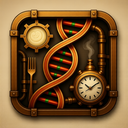
Imagine an intricate, visionary icon that fuses three seemingly disparate realms—food, DNA strand, and steampunk—into a single, captivating aesthetic experience. This is not just a visual combination; it is a narrative of fusion, innovation, and life’s fundamental rhythms. At its core lies the concept of nourishment: food—the essence of sustenance, culture, evolution—and yet this food does not exist in the ordinary sense. It emerges from within the very structure of life itself: DNA. The icon portrays a living organism’s blueprint—its genetic code—reimagined through the lens of Victorian-era machinery and industrial imagination. Steampunk, with its brass gears, copper pipes, cogs, and atmospheric fog, provides both the visual language and emotional tone. It evokes an age of invention where science meets craftsmanship, where nature is not just observed but engineered. In this icon, those elements merge into a harmonious yet rebellious symbiosis.
The central feature of the icon is a stylized DNA double helix, but instead of being rendered in flat lines or biological realism, it is transformed into a complex mechanical construct. Each rung of the helix is not composed of simple base pairs (A-T, G-C), but rather forms an intricate gear system. Adjoining each pair are brass gears that interlock like clockwork mechanisms, turning slowly as if powered by internal steam pressure. The spiraling structure ascends vertically, suggesting a vertical tower or a central organ—perhaps a "laboratory of life"—where the very principles of biology are processed and regulated through mechanical precision. Each step of the helix is embossed with small engraved motifs: tiny illustrations of fruits, seeds, and vegetables—think tomatoes, wheat grains, apples—rendered in intricate etchings reminiscent of Victorian botanical illustrations.
Surrounding the DNA structure are elements that represent food not just as nourishment but as a dynamic force within the ecosystem. Instead of being mere background elements or simple depictions, food items appear integrated into the steampunk framework. For instance, one side of the helix features a copper-capped fruit press, its gears grinding apples into juice that flows through brass tubing into a central reservoir. On another section, a tiny steam-powered griddle simulates the sizzling of bacon or seared mushrooms—flames rendered in stylized candlelight with sooty particles swirling around them. These food elements are not decorative; they serve as active components in the machine, suggesting that food is both a product and a power source within this world. The steam generated from these culinary operations feeds the DNA structure, powering its rotation—a metaphor for how nutrition fuels biological processes.
As the DNA helix ascends, it branches into multiple arms resembling pistons or pistons driven by clockwork levers. Each arm terminates in a small brass dish or pan containing different foodstuffs—rice grains suspended in a vapor-like state, steamed vegetables rising like mist from open vents, or even a tiny steam-powered oven that emits warm golden light. These dishes are not just static; they appear to be rotating slowly due to the influence of internal gears and pistons, reflecting the concept of continuous biological cycles and metabolism. This dynamic movement reinforces the idea that food is not consumed in isolation—it is part of a constant, self-sustaining engine.
The steampunk aesthetic permeates every element. The entire icon is bathed in an atmosphere of industrial warmth—copper rivets, brass plates, exposed gears with visible teeth, and fog-like tendrils that curl from the edges like steam escaping from a boiler room. The background subtly features a vintage-style cityscape: cobbled streets, gas lamps flickering with soft amber light, and distant chimneys belching smoke. Even the font used to label or describe this icon—should it exist—would be an ornate, serif typeface reminiscent of 19th-century engineering manuals. The color palette is rich and earthy: deep rusts, burnt sienna, oxidized copper, and warm browns contrasted with vibrant greens and blues that represent the natural life encoded within the DNA.
What makes this icon truly unique is its conceptual depth. It suggests a world where biology and technology are not opposing forces but collaborators. The food provides energy; the DNA stores knowledge; the steampunk machinery brings them together into a living, breathing system. This could symbolize modern bioengineering—where scientists use genetic modification to create crops that are more resilient or nutritious, all while relying on mechanical automation for precision and efficiency. Alternatively, it could represent a philosophical vision of sustainable living: where we understand the interplay between human nutrition and biological systems through the lens of innovation.
The icon also carries a sense of mystery and wonder. The gears within the DNA appear to be moving in patterns that resemble natural sequences—like Fibonacci spirals or fractal growths—blending mathematical precision with organic rhythms. This fusion of scientific truth and artistic expression is central to steampunk’s appeal: it respects the real world while imagining a more imaginative, functional version of it. The food elements serve as emotional anchors—reminders of human connection, tradition, and daily sustenance—while the DNA strand represents the invisible forces that shape life itself.
In essence, this icon is not merely a visual design—it is a metaphor for harmony between nature and technology. It celebrates food as both a cultural artifact and a biological necessity; it honors DNA as the foundation of all living things; and it embraces steampunk as an artistic philosophy that values craftsmanship, invention, and the beauty of mechanical ingenuity. Through its intricate details, dynamic motion, and rich symbolism, this icon invites viewers to reconsider how we interact with food, science, and our environment. It stands not just as a fusion of three elements but as a vision for a future where nature is not suppressed by technology—but instead is elevated through it.
Create your own icon with our GoGPT AI prompt:
GoGPT