

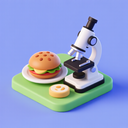
Food Microscope 3D isometric – Free icon download
Download all to grab every PNG variant.
In today’s rapidly evolving digital landscape, visual communication plays a pivotal role in conveying complex ideas with clarity and engagement. One such innovation is the creation of an icon that seamlessly blends three distinct yet profoundly meaningful themes: Food, Microscope, and 3D Isometric. This intricate and thoughtfully designed icon serves not only as an aesthetic component in user interfaces, mobile applications, or educational tools but also as a symbolic bridge between the biological sciences and culinary arts—two fields that often seem distant from one another. Through its fusion of these elements, the icon becomes more than just a visual motif; it embodies curiosity, discovery, and the interconnection between life and nutrition.
The core structure of this icon is rooted in 3D isometric projection, a geometric technique that presents three-dimensional objects on a two-dimensional plane using equal angles (typically 120 degrees) to maintain depth perception. This approach gives the icon a modern, dynamic, and technically precise appearance. The use of isometric design ensures that every element—be it food or microscope components—is rendered in true spatial relationships, creating an immersive and intuitive user experience. Unlike flat or simple icons, this 3D isometric version allows viewers to mentally “look through” the object as if they are standing beside it, enhancing visual engagement and cognitive recognition. This technique is widely used in architectural visualization, game design, and technical illustrations because of its ability to convey spatial complexity without requiring prior knowledge.
At the heart of this icon lies a microscope, symbolizing scientific inquiry and detailed observation. The microscope is rendered in a clean, stylized form with precise lines and realistic depth cues. It features a magnifying lens with subtle gradient lighting to suggest focus and clarity, while its base includes an abstract representation of fine grid patterns—evoking the microscopic world where cells, bacteria, or molecular structures are studied. The microscope’s arm is slightly angled to align naturally with the isometric framework, ensuring it fits seamlessly into the overall composition without visual distortion. This element represents scientific rigor and attention to detail—qualities essential in understanding biological systems at their most fundamental level.
Integrated into the structure of the microscope is a food component, specifically a microscopic view of a food molecule or cell. Rather than depicting traditional food items such as fruits or meals, this icon focuses on molecular-level representations—such as the crystalline structure of sugar, the lipid bilayer of a cell membrane in cheese, or the cellular composition of plant tissues. This choice transforms the concept from mere cuisine into a scientific exploration of nutritional components. The food element is rendered using subtle textures and gradients that mimic real-world materials under magnification. For instance, starch molecules might appear as interlocking hexagons with slight variations in color to suggest different types of carbohydrates.
The interaction between the microscope and food elements is carefully choreographed within the 3D isometric framework. The food component appears to be “inside” or “beneath” the microscope’s lens, suggesting that through scientific tools, we can observe the internal composition of everyday foods. This narrative adds a layer of educational value—viewers immediately understand that science and nutrition are not separate domains but deeply interconnected disciplines. For example, studying how nutrients are structured at a cellular level provides insight into their digestion, absorption, and overall health impact.
The color palette of the icon is strategically chosen to reflect both scientific precision and organic life. Cool tones—such as teal, light blue, and silver—are used for the microscope components to suggest clarity, focus, and technical accuracy. In contrast, warm hues like amber, rust reds, and soft gold are applied to the food elements to evoke freshness, natural ingredients, and vitality. The interplay between these colors creates visual harmony while reinforcing the duality of science and nature. Additionally, subtle highlights on the 3D surfaces simulate realistic lighting conditions as if viewed under a microscope with natural light.
The icon’s design is scalable and universally applicable across digital platforms—mobile apps, websites, educational software, or even scientific dashboards. Its modular structure allows for easy customization: users can expand the food component to show different nutrients (proteins, fats, fibers), or adjust the microscope lens to represent different magnification levels. This adaptability makes it a versatile asset in applications focused on nutrition science, health monitoring, or biology education.
From a psychological standpoint, this icon taps into human curiosity. The combination of food and microscopy appeals to both the practical (what we eat) and the intellectual (how we understand it). It triggers an emotional response—something familiar (food) meeting something unfamiliar (the microscopic world), which encourages exploration and learning. In classrooms or wellness apps, such an icon can serve as a gateway to deeper discussions about food science, digestion, or even sustainable agriculture.
Moreover, this icon challenges conventional boundaries between disciplines. It reflects the growing trend in interdisciplinary thinking—where science and lifestyle converge. Whether used in a children’s learning app that teaches about nutrition through microscopy, or in a health platform analyzing dietary impacts on cellular health, the icon becomes a powerful metaphor for holistic wellness.
In conclusion, the 3D isometric icon combining Food, Microscope, and 3D isometric design is not just a visual representation—it is a multidimensional symbol of discovery. It bridges everyday life with scientific inquiry, making complex concepts accessible and engaging. By leveraging the depth, clarity, and spatial accuracy of 3D isometric rendering, it transforms abstract ideas into tangible visuals that resonate with users across age groups and backgrounds. This icon exemplifies how thoughtful design can merge aesthetics with meaning, creating a visual language that educates as much as it entertains.
Create your own icon with our GoGPT AI prompt:
GoGPT