

Nature House Steampunk – Free icon download
Download all to grab every PNG variant.
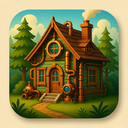
At the heart of this intricately designed icon lies a profound fusion of three distinct yet deeply resonant themes: Nature, House, and Steampunk. This is not merely a combination of aesthetic styles — it is a conceptual masterpiece, where the raw vitality of the natural world harmonizes with the sheltering embrace of domestic life, all filtered through the imaginative lens of Steampunk. The icon serves as both an artistic representation and a symbolic narrative about human connection to nature, innovation within tradition, and sustainability through technological reverence.
Visualizing this icon begins with a central structure — a House that rises from the earth like a living organism. Rather than being constructed from cold steel or modern glass, the house is built of weathered wood, copper pipes, and wrought iron details, all of which are seamlessly integrated into the surrounding environment. The roof is arched and domed, reminiscent of a natural hillside or ancient tree canopy — its surface adorned with brass ventilation flaps that resemble leaves in motion. These flaps gently sway in imagined breezes, suggesting a dynamic relationship between the structure and its environment. Windows are not simply openings; they are circular lenses set into the walls, each containing intricate gearwork and tiny brass instruments that seem to pulse faintly with internal energy — a subtle nod to both mechanical complexity and natural rhythms.
Surrounding the house is a vibrant Nature that does not merely coexist with it — it grows *through* it. Thick vines curl around the walls, their leaves shaped like gears or cogs, blending organic forms with industrial details. These vines are not just decorative; they appear to have functional roles — some carry small solar-powered bulbs made of polished quartz, others hold miniature wind turbines that spin slowly in the breeze. The ground beneath is rich with moss and wildflowers arranged in patterns resembling ancient maps or mechanical schematics, suggesting that nature here has been both nurtured and guided by human design. Trees grow from the base of the house like pillars, their trunks etched with engraved runes — not magical symbols, but blueprints of steam-powered systems used to regulate temperature, purify air, and generate energy through solar and wind convergence.
The Steampunk element is not a superficial addition but the very soul of the icon. This world does not rely on futuristic tech — it embraces a retrofuturism rooted in Victorian-era aesthetics, where science is seen as an extension of nature rather than its dominion. The house’s mechanical heart is visible through large brass valves and copper conduits running from floor to ceiling, forming a network that resembles the circulatory system of a living being. Steam vents rise from the center of the roof like breaths exhaled by a sleeping animal, their steam not only visible but gently condensing into droplets that fall like dew onto nearby ferns. These droplets trigger tiny electrical signals — invisible to the eye — which are then transmitted through copper wires embedded in the soil, creating a feedback loop between nature and machine.
One of the most striking features is a central garden greenhouse located at the front of the house. This structure is made entirely from recycled brass and iron, with transparent glass panels that have been etched with botanical patterns — flowers like lilies, daisies, and willows — which are mirrored in gear shapes. Inside, plants grow in vertical terraces powered by a miniature steam engine that runs on biomass collected from fallen leaves. The engine is not loud or intrusive; instead, its hum is soft and rhythmic, similar to the sound of wind through trees. This integration shows how Steampunk technology doesn't replace nature — it supports and sustains it.
Moreover, the icon embodies a philosophical harmony between humanity's need for shelter and its responsibility to preserve natural balance. The house is not isolated; it is a community node in a larger network of such structures scattered across hillsides and valleys, all connected by copper cables that carry energy, messages, and information — but always with respect for local flora. In this world, the House serves as both sanctuary and steward — a place where people live in balance with nature through technology that respects its rhythms. The Steampunk machinery is not a symbol of domination; it is an expression of curiosity, innovation, and reverence for the elements.
This icon reflects a broader vision: that sustainable living does not require abandoning the past or rejecting modernity. Instead, it demands reimagining them through a lens of ecological consciousness. The Steampunk style offers an alternative narrative — one in which progress is measured not by speed or power, but by harmony, endurance, and beauty. The house becomes a monument to coexistence — where nature breathes into the mechanical parts and mechanical systems breathe with the pulse of the earth.
In essence, this icon is more than a visual image; it is a manifesto for an eco-conscious future built on imagination, tradition, and respect. It invites viewers to envision homes not as isolated structures but as living ecosystems — where nature and industry merge in symbiosis. Whether viewed as art, design inspiration, or symbolic representation of sustainable communities, this fusion of Nature, House, and Steampunk stands as a beacon of hope — reminding us that technology need not come at the cost of the natural world. Instead, it can be an extension of it.
Create your own icon with our GoGPT AI prompt:
GoGPT