

Nature Robot Line art – Free icon download
Download all to grab every PNG variant.
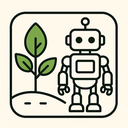
The icon titled "Nature, Robot, and Line Art" is a visually striking and conceptually rich piece that seamlessly fuses three distinct yet harmonious elements: Nature, Robot, and Line Art. This icon is not merely a simple graphical representation; it is a carefully crafted synthesis of organic forms from the natural world merged with mechanical precision of artificial intelligence — all rendered in elegant, minimalist line art. The result is an artwork that transcends traditional iconography by inviting viewers to contemplate the relationship between humanity’s technological advancements and the enduring beauty of nature.
At its core, the icon features a stylized robot composed entirely of flowing, organic lines reminiscent of plant structures such as vines, roots, leaves, and branches. The robot's body is not constructed with rigid geometric shapes or sharp edges — instead, it appears to grow from the earth like a tree emerging from soil. Its limbs resemble long tendrils that curl and unfurl in a manner similar to how vines climb walls or how roots spread beneath the surface of the ground. This design choice emphasizes fluidity and natural motion, reinforcing the central theme of integration between artificial life and natural ecosystems.
The robot’s head is particularly striking — it takes the form of a smooth, rounded shape resembling a blooming flower or an open blossom. The center features subtle concentric lines that suggest petals opening in slow motion, with fine strokes mimicking sunlight filtering through leaves. This fusion of botanical imagery with robotic design creates a sense of harmony and balance, suggesting that technology can coexist peacefully with nature rather than dominate it.
Every line in the icon is drawn using clean, thin strokes — a hallmark of line art. There are no solid colors or gradients; instead, the entire composition relies on subtle variations in stroke weight and direction to create depth and dimension. Thick lines represent sturdy structural elements such as a central trunk or root system, while thinner lines suggest delicate features like spider webs, leaf veins, or fine branches. This monochromatic approach enhances the icon’s universality — it can be used across various digital platforms without being overwhelmed by color schemes or background distractions.
From a design standpoint, the integration of nature and robotics is not arbitrary. The lines of the robot flow in patterns that mirror natural growth — spirals, branching systems, fractal-like formations — all derived from biological principles observed in trees, rivers, and neural networks. This reflects an underlying philosophy that both biological and artificial systems follow similar mathematical rules governing complexity and evolution. In this way, the icon serves as a visual metaphor for the emerging field of bio-inspired robotics or biomimetic engineering.
The background of the icon is left intentionally blank — a deliberate choice that emphasizes focus on form rather than context. This minimalism is characteristic of high-quality line art, allowing viewers to concentrate entirely on the interplay between organic and mechanical forms. The absence of background elements also gives the icon an ethereal quality, as if it exists in a vast natural landscape where technology has gently woven itself into the environment.
Functionally, this icon is designed for versatility across digital environments — from user interfaces and mobile applications to websites and educational tools. Its minimalist aesthetic ensures high scalability and clarity at any size, making it ideal for use on small screens or in low-resolution contexts. Because it relies solely on line art, the icon remains accessible even on older devices or in systems with limited graphical capabilities.
Moreover, this icon carries deeper symbolic meaning. In a world increasingly shaped by artificial intelligence and automation, the image serves as a subtle reminder of our dependence on and responsibility toward nature. The robot is not portrayed as a cold machine threatening the environment — instead, it is shown growing from the soil, nourished by sunlight and rain, suggesting symbiosis rather than domination. This visual narrative promotes eco-consciousness among users who encounter it in digital spaces.
From an artistic perspective, the icon bridges two seemingly opposing domains: the mechanical precision of robotics and the organic unpredictability of nature. The use of line art allows for a delicate balance between structure and spontaneity. Lines that would normally represent hard edges in robot designs here instead mimic the natural flow found in water or wind — creating a sense of motion and life.
Artists who create such icons must possess both technical skill and deep understanding of natural systems. The design process likely involved studying botanical illustrations, analyzing plant growth patterns, and applying principles from computer science related to algorithmic design. It reflects a growing trend in modern iconography where aesthetics are not only about visual appeal but also about conveying meaning and fostering emotional connection.
The icon’s appeal lies in its ability to spark curiosity. When viewed quickly, it may seem like a simple robot or plant; upon closer inspection, however, viewers begin to notice the intricate details — how the lines curve like tree branches, how the robot’s limbs mimic root systems spreading into unseen depths. This layered perception encourages active engagement with the artwork.
Ultimately, "Nature, Robot and Line Art" is not just a digital icon — it is a statement on our evolving relationship with technology and the natural world. It challenges conventional thinking by proposing that robots do not have to be alien or inhuman; they can be extensions of nature, grown rather than built. In a time when climate change and environmental degradation are pressing concerns, this icon stands as both a hopeful vision and a call to action — reminding us that innovation should not come at the cost of ecological balance.
In conclusion, the "Nature, Robot and Line Art" icon masterfully combines three essential elements into one cohesive, thought-provoking image. Its elegance lies in its simplicity: every line serves a purpose, every form echoes a natural rhythm. Whether used in education to teach about sustainability or as part of a tech brand’s identity to convey innovation with responsibility, this icon remains timeless — not just for its beauty, but for the deeper truth it communicates: nature and technology are not adversaries; they can grow together in harmony.
Create your own icon with our GoGPT AI prompt:
GoGPT