

Transportation Factory Cyberpunk – Free icon download
Download all to grab every PNG variant.
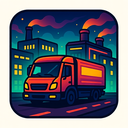
The icon depicted represents a powerful fusion of Transportation, Factory, and Cyberpunk aesthetics — an immersive visual narrative set within the dystopian, high-tech world of the 22nd century. At its core lies a massive vertical transportation hub suspended above an underground industrial complex, merging the sleek movement of futuristic transit with the mechanical rigor of automated production. This is not merely a static image; it is a dynamic symbol that captures motion, industry, and technological dominance — all underpinned by the cyberpunk ethos of neon-lit dystopia and human-machine integration.
The central feature of this icon is an elevated transit network that spirals upward from the ground like a colossal data-fueled spine. This transportation system consists of self-repairing mag-lev pods, hovering hover-trams, and autonomous drones that glide between interconnected platforms in a synchronized rhythm — each pod pulsing with soft blue and electric green lighting, mimicking neural signals. These vehicles do not operate by traditional schedules or human control; instead, they are managed by an AI-driven central network that processes real-time traffic data using quantum algorithms embedded within the factory’s core infrastructure. The transportation layer symbolizes efficiency, scalability, and the seamless flow of goods and people across a hyper-urbanized cybernetic landscape.
Below this vertical transit corridor lies a sprawling underground Factory. It is not an old-fashioned industrial complex but one forged from bio-mechanical alloys and self-assembling modular units. The factory walls are made of semi-transparent, adaptive polymer panels that shift in texture and color depending on the phase of production — glowing orange when processing raw data streams, deep crimson during high-output manufacturing cycles. Within these walls, robotic arms with biomechanical tendons move with eerie precision, welding together carbon-fiber drones or assembling neural interface modules. Autonomous drones fly through the factory ceiling like swarms of insect-like sensors, scanning for anomalies and optimizing workflow using machine learning models trained on decades of production data.
The cyberpunk aesthetic permeates every element. The entire environment is bathed in a perpetual twilight glow — neon signs flicker with glitchy, fragmented text in multiple languages, displaying messages like "Cargo 7D - Delivered," "System Overload Detected," or "Worker Status: Active." The air shimmers with holographic advertisements for illegal data markets, augmented reality services, and experimental neural implants. Surveillance drones hover silently in the upper levels, their lenses scanning faces with uncanny accuracy — a constant reminder of how surveillance and control are woven into the fabric of urban life. Every surface reflects a digital afterimage: liquid screens that pulse with code fragments, floating glyphs that rotate slowly like broken clock hands, and walls covered in augmented reality graffiti written by anonymous hackers.
The intersection between Transportation and Factory is particularly striking. The transportation hub isn’t just a separate entity — it is intrinsically linked to the factory floor. Every pod that enters or exits the transit system triggers a micro-digital signature, which is logged into the factory’s central command node. This creates a real-time feedback loop: when demand increases, more pods are dispatched; when production slows, fewer resources are allocated. The transportation network functions as both a delivery system and an energy conduit — kinetic energy from moving pods is harvested and fed directly into the factory’s power grid, which runs on recycled solar radiation captured through transparent domes above the city.
Human presence is minimal but never absent. A few figures are visible in the background — cyber-enhanced workers wearing neural-linked helmets that project augmented views of production timelines. Their movements are fluid and efficient, as if guided by internal AI cues rather than conscious thought. Some stand atop elevated platforms, watching the transit flow with detached curiosity, while others operate maintenance drones that repair failing systems using self-repairing nanite patches. These workers represent the fusion of human agency with machine intelligence — a hallmark of cyberpunk society where humans are both enablers and augmented by technology.
Environmentally, this icon reflects the dystopian reality of cyberpunk cities: overpopulation, resource scarcity, and environmental degradation masked by technological brilliance. The factory emits faint emissions that pollute the atmosphere, yet its outputs — smart materials, autonomous vehicles, and human interface units — are essential to the city’s survival. The transportation network moves not just people but data packets, biological samples, and even synthetic organs — all integral to maintaining life in this post-scarcity future.
Symbolically, the icon serves as a metaphor for modern industrial evolution. It represents how traditional manufacturing is being reimagined through advanced automation, artificial intelligence, and sustainable energy integration. At the same time, it warns of the ethical dilemmas that arise when transportation and production become entirely machine-controlled — questions about privacy, labor rights, and human autonomy remain unresolved.
In essence, this icon embodies a world where Transportation is not just movement but a vital data stream; where Factory is no longer a place of labor but an evolving organism powered by intelligence; and where the Cyberpunk aesthetic serves as both visual identity and philosophical commentary on technology's role in shaping human destiny. It stands as a beacon — not of hope, but of cautious evolution — in the age of artificial intelligence, autonomous systems, and ever-expanding digital networks.
This icon is more than an image; it is a narrative device that captures the pulse of a future where machines govern movement and production while humans struggle to retain meaning in a world ruled by code.
Create your own icon with our GoGPT AI prompt:
GoGPT