

Transportation Train Formal – Free icon download
Download all to grab every PNG variant.
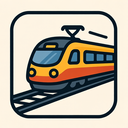
The "Formal Transportation - Train" icon is a meticulously designed, high-precision visual symbol that embodies elegance, reliability, and structured movement—representing the convergence of modern transportation systems with formal aesthetics. This icon is not merely a simple illustration of a train; it is an artistic and semantic expression crafted to communicate professionalism, efficiency, and institutional trust in the context of public or corporate transit networks.
At its core, this icon centers on a stylized train that emerges from the ground with clean lines, balanced proportions, and geometric symmetry. The design follows classical principles of formality—emphasizing clarity, proportionality, and restraint. Every curve and straight edge is carefully measured to reflect a sense of order and predictability. Unlike chaotic or overly decorative depictions of trains found in casual or informal media, the "Formal Transportation - Train" icon adheres to a minimalist yet sophisticated design language that elevates the train from mere machinery into a symbol of civic infrastructure and organized mobility.
The train itself is rendered with subtle gradients and monochromatic tones—typically shades of navy blue, silver gray, or deep black—to convey a sense of authority, professionalism, and timelessness. These colors are not chosen randomly; they reflect the traditional aesthetic of government-operated rail services such as those found in Europe or established transit agencies in North America. The use of these formal palettes ensures that the icon maintains a dignified appearance regardless of its application—whether on corporate reports, official transportation maps, or executive presentations.
Each carriage is depicted with precision and symmetry. The windows are rectangular and evenly spaced, giving the illusion of uniformity and consistency in service. The design avoids excessive detail such as graffiti, modern digital displays, or passengers to maintain its formal tone. Instead, the focus is on structure—highlighting the train as a reliable system rather than a dynamic social space. This deliberate omission reinforces its role as an emblem of efficiency and institutional trustworthiness.
The surrounding elements are equally important in defining the icon's formal character. The train appears to emerge from a clean, abstract platform that suggests urban or suburban infrastructure without specifying location. This abstraction allows the icon to be universally applicable across various contexts—be it city planning documents, international logistics reports, or boardroom presentations on sustainable transportation solutions.
Transportation is not just a function of movement in this icon—it is represented as a structured system that ensures safety, punctuality, and accessibility. The design incorporates subtle directional cues—such as parallel lines extending from the train's front and rear—to symbolize the continuous flow of scheduled services. These lines are thin yet prominent, emphasizing continuity and predictability—key attributes associated with formal transportation networks.
The integration of "Train" as a central motif is both literal and symbolic. The train serves as a metaphor for organized progress—its movement representing the steady advancement of society through structured systems. In many cultures, trains are associated with journeys across time, distance, and societal development. This icon leverages that cultural resonance to suggest not just transportation but also journey toward efficiency, sustainability, and civic responsibility.
Moreover, the "Formal" aspect of this icon extends beyond visual aesthetics into its symbolic function. It is intended for use in professional environments such as government agencies, corporate sustainability departments, international transport planning committees, or educational institutions studying urban development. The icon's tone is authoritative yet respectful—suitable for inclusion in official documents, presentations to stakeholders, or branding materials that require a sense of gravitas and reliability.
When placed within a larger visual hierarchy—such as on a dashboard of public transportation options—the "Formal Transportation - Train" icon stands out due to its clarity and composure. It does not compete visually with other icons; instead, it integrates seamlessly into formal layouts by maintaining consistent spacing, alignment, and color schemes. This makes it ideal for use in digital platforms where user experience and visual harmony are paramount.
Additionally, this icon is designed to be scalable across various mediums—from large-scale posters in transit hubs to small digital badges on mobile apps—without losing its formal integrity. Whether displayed on a high-resolution screen or printed on a government brochure, the icon retains its refined appearance and message of stability and professionalism.
From a design perspective, the icon draws inspiration from classical European train depictions found in 19th-century engineering illustrations and early 20th-century public service signage. However, it is not nostalgic or archaic—it is modernized to reflect current values such as sustainability, accessibility, and technological integration. For instance, while the train itself remains traditional in form, subtle elements like a faint digital glow beneath the carriages suggest the incorporation of smart systems—such as real-time tracking or energy efficiency monitoring—without compromising its formal tone.
The "Formal Transportation - Train" icon is more than a visual element; it is a statement. It communicates that transportation, when executed with discipline and care, becomes a pillar of societal progress. It suggests that mobility should not be seen as merely logistical but as an act of civic responsibility—an essential component of formal urban life.
In conclusion, the "Formal Transportation - Train" icon is a powerful fusion of function and form. By seamlessly integrating the keywords "Transportation," "Train," and "Formal," it creates a symbol that is both practical and profoundly meaningful. It stands as a visual ambassador for reliable, structured, and dignified movement in modern society—ideal for professional settings where trust, consistency, and efficiency are paramount.
Create your own icon with our GoGPT AI prompt:
GoGPT