

Transportation Train Metallic – Free icon download
Download all to grab every PNG variant.
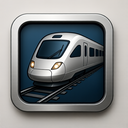
The "Transportation, Train, and Metallic" icon is a meticulously designed visual symbol that masterfully merges functionality with aesthetic elegance to represent modern mobility systems grounded in industrial strength and technological precision. At its core, this icon serves as a powerful visual metaphor for the dynamic evolution of urban transportation—specifically focusing on rail-based transit systems. The integration of the keywords "Transportation," "Train," and "Metallic" is not merely surface-level; it forms the foundation of every design element, ensuring that each aspect of the icon conveys meaning, utility, and sophistication.
Firstly, in terms of Transportation, this icon embodies the essence of efficient, large-scale movement. It is conceived as a central node in a broader system where people and goods flow seamlessly across cities and regions. The icon reflects the reliability, consistency, and connectivity that define modern transportation infrastructure. Unlike generic representations of vehicles or roads, this symbol captures the rhythm and structure of public transit—emphasizing punctuality, networked routes, and accessibility. It evokes the idea of movement as a fundamental human necessity: commuting to work, accessing education, or traveling for leisure—all supported by organized systems designed to serve diverse populations. The design subtly suggests integration with other forms of transportation such as buses or bicycles through interconnected lines or nodes that extend outward from the main train form.
The central motif of the icon is a stylized Train, rendered with geometric precision and dynamic balance. It is not a literal depiction of a train car, but rather an abstract interpretation that captures its essence—length, motion, and mechanical consistency. The train is composed of segmented modules aligned vertically or horizontally depending on the orientation, symbolizing both the continuity of service and the modular nature of rail systems. Each module features sharp edges and clean lines to suggest speed and efficiency. The shape subtly mimics a moving vehicle in motion—slightly angled at the front to imply forward progression, with a slightly tapered rear that conveys finality or completion of a journey. The wheels are not explicitly shown but suggested through subtle circular motifs embedded along the base of each car, reinforcing the mechanical foundation and movement.
Moreover, this train form is not static; it pulses with life through motion lines—thin, rhythmic strokes that run along its body like current or velocity. These lines are not merely decorative; they represent speed, flow, and the constant movement of passengers throughout a 24-hour cycle. The motion lines increase in density as they approach the center of the icon, symbolizing high-traffic periods such as morning commutes or evening rush hours. This dynamic layer adds depth and realism to what could otherwise be a flat symbol, making it feel active and responsive to real-world usage.
The defining characteristic that sets this icon apart is its strong emphasis on Metallic elements. From the very first stroke of the design, metallic textures are embedded throughout. The color palette primarily features deep tones such as matte silver, gunmetal gray, and polished steel—colors associated with durability, industrial strength, and long-term functionality. These hues convey a sense of permanence and resilience; they suggest that the transportation system is built to last through decades of use. The metallic finish gives the icon a reflective quality when viewed under light, creating subtle highlights that enhance its three-dimensional presence even in digital environments.
Visually, the metallic surface is achieved through a combination of gradients and subtle surface texture overlays. The train body exhibits micro-reflective patterns—like tiny facets or polished surfaces—that mimic real-world rail equipment. These textures are not overly detailed to avoid clutter but are purposefully minimal, allowing the form to remain elegant and legible across various screen resolutions and sizes. The metallic tone also provides excellent contrast against backgrounds, making the icon highly visible in both digital interfaces (such as transit apps or city planning platforms) and printed materials like maps or posters.
From a design philosophy standpoint, this icon reflects the convergence of industrial heritage and modern technology. It honors the historical significance of trains—first used for long-distance travel, then adapted into urban commutes—as a symbol of progress and connectivity. At the same time, it speaks to contemporary innovations in rail transportation: electric-powered trains, smart signaling systems, real-time tracking apps, and sustainability goals. The metallic finish suggests not only strength but also innovation—modern materials such as lightweight alloys or composite metals that improve energy efficiency and reduce environmental impact.
Additionally, the icon is scalable and adaptable. Whether used in a mobile app interface for a transit agency, on a city’s official website, or in public signage at train stations, the "Transportation, Train, and Metallic" icon retains its clarity and meaning. Its design adheres to universal principles of visual communication—simple shapes with clear symbolic intent—ensuring that it is instantly recognizable even to users who may not be familiar with rail systems. This adaptability enhances its utility in cross-cultural contexts where language barriers might exist.
Furthermore, the icon's use of metallic tones aligns with global trends toward sustainable and durable urban infrastructure. In a world increasingly focused on reducing carbon footprints, the train—as a low-emission transportation mode—becomes a beacon of environmental responsibility. The metallic design reinforces this message by associating trains with clean technology and long-term viability. It communicates that investing in rail-based systems is not just practical but also eco-conscious.
In summary, the "Transportation, Train, and Metallic" icon is more than a simple graphic—it is a comprehensive symbol of modern urban mobility. It seamlessly integrates the functionality of transportation with the reliability and efficiency of train systems while embracing the aesthetic and symbolic power of metallic materials. Through its thoughtful design choices—clean lines, motion elements, reflective textures, and purposeful color—this icon becomes both visually striking and deeply meaningful to users across demographics. It stands as a testament to how design can convey complex ideas with clarity, elegance, and emotional resonance.
Whether in digital media or physical environments, this icon serves as a beacon of connectivity, progress, and sustainable movement for the future of transportation.
Create your own icon with our GoGPT AI prompt:
GoGPT