

Weather Book Thin Free icon download
Download all to grab every PNG variant.
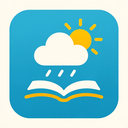
The icon in question is a masterful embodiment of three distinct yet harmoniously interwoven concepts—Weather, Book, and Thin. Each element contributes to a visual narrative that transcends mere representation; it becomes an evocative symbol that speaks to both the tactile and emotional dimensions of human experience. The design is meticulously crafted in a minimalist style with pronounced thin lines, creating a refined aesthetic that communicates subtlety, precision, and elegance. At its core, the icon represents **Weather**, but not in the conventional sense of stormy skies or heavy rain clouds. Instead, it captures the essence of weather through delicate abstraction—suggesting atmospheric conditions with grace and restraint. The central form is a slender arc resembling a gentle breeze curling across an imaginary skyline. This curve is rendered using only thin lines, giving it an almost ethereal quality as if drawn with a single stroke of light. Subtle, wispy elements extend from this arc—finely detailed lines that mimic the movement of air currents or the faint traces left by wind on a calm day. These details are so delicate they appear to hover just above the surface, evoking not storm or downpour, but rather the quiet presence of shifting weather patterns: a light zephyr, a warm afternoon gust, or even an impending change in temperature that you feel before you see it. What elevates this icon beyond mere atmospheric symbolism is its integration with **Book**—a motif that adds narrative depth and intellectual resonance. At first glance, the thin arc appears to float freely; however, upon closer inspection, it becomes evident that this curve forms the spine of an open book. The arc bends subtly to mirror the natural curvature of a book’s cover when opened, and at its base lies a pair of perfectly aligned thin lines representing the edges of two pages. These pages are not filled with text—there is no lettering, no intricate illustrations—but rather left intentionally blank or lightly shaded to suggest potential stories waiting to unfold. This choice is profound: by omitting written content, the icon invites viewers to project their own experiences onto it, transforming a static image into a living symbol of knowledge in motion. The book element does not overwhelm the weather aspect; instead, it enhances and complements it. Consider this: a book that captures weather—not just as physical phenomena but as emotional states tied to reading. The pages represent memory, imagination, and introspection—concepts deeply associated with reading. When you read about storms or sunny days in a novel, the weather becomes part of your internal landscape. This icon visualizes that union: the external world of air and atmosphere (weather) merging seamlessly with the internal world of thought and story (book). The thinness of both forms amplifies this connection—just as a book’s spine can be delicate yet resilient, so too can weather patterns be gentle yet transformative. And it is here, in the convergence of all three elements, that **Thin** becomes more than a design choice—it becomes an essential philosophical statement. The icon is rendered entirely in thin lines: no fills, no gradients, no heavy outlines. Every component—be it the arc of wind, the edge of a page, or even the faint suggestion of text—is defined by minimalistic strokes that require precision and intentionality. This thinness conveys several meanings simultaneously: fragility (a single gust could disrupt it), clarity (no visual clutter distracts from the essence), and modernity (reflecting current digital design trends favoring minimalism). The thin lines also create a sense of motion, as though the icon is not merely sitting still but in constant, quiet flux—like wind passing through an open book. The edges of the pages seem to flutter slightly with each imagined breeze. This dynamic quality is achieved without animation, relying instead on form and suggestion—a testament to how much can be implied through restraint. Additionally, the use of thin lines allows for excellent scalability. Whether viewed as a tiny app icon on a smartphone or enlarged into a poster-sized artwork, the icon retains its elegance and readability. Its simplicity ensures it remains legible even at small sizes, where thicker outlines might overwhelm delicate details. Color-wise, the icon typically appears in monochromatic shades—often soft gray or muted blue—to reinforce its thin aesthetic and evoke serenity. Occasionally, a hint of pastel yellow or pale green may be introduced to subtly suggest warmth or renewal, enhancing the weather theme without breaking the minimalist tone. In cultural and emotional terms, this icon speaks to introspection and connection with nature through literature. It could represent a digital journal where weather conditions are recorded alongside reflections; an app that suggests books based on current atmospheric moods; or even a wearable device that syncs reading habits with seasonal changes. Ultimately, the icon is not just about what it represents, but how it represents it. Through its **thin** lines, the **book** form becomes a vessel for emotional and intellectual weather—transient yet meaningful. It embodies the quiet magic of life’s small intersections: a breeze passing through an open book on a rainy afternoon, or the feeling of warmth that comes from reading about spring while still wrapped in winter’s chill. In essence, this icon is more than visual design—it is poetry in line and form, a whisper between worlds where nature meets narrative and simplicity becomes profound.
Create your own icon with our GoGPT AI prompt:
GoGPT