

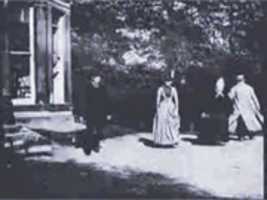
Earliest Extant Film: Roundhay Garden Scene of 14 October, 1888
Ad
TAGS
Download or edit the free picture Earliest Extant Film: Roundhay Garden Scene of 14 October, 1888 for GIMP online editor. It is an image that is valid for other graphic or photo editors in OffiDocs such as Inkscape online and OpenOffice Draw online or LibreOffice online by OffiDocs.
Earliest Extant
Film: Roundhay Garden Scene of 14 October, 1888 From Louis
Aime Augustin Le Prince
of film has ever been produced which pre-dates this one.
It is known as the Roundhay Garden Scene. Le Prince photographed this sequence
(2-3 weeks prior to Leeds) in the garden of the
Whitley home, (home of his father-in-law) Roundhay,
Leeds.
LOUIS AIME AUGUSTIN LE PRINCE (1841 - 1890)
Le Prince begins initial work
on his motion picture experiments and in 1886 applies
for a patent for the production of animated pictures.
LOUIS AIME AUGUSTIN LE PRINCE (1841 - 1890)
A
Frenchman working primarily in Leeds England, who earlier had emigrated
to the U.S., Le Prince patents in the U.S., a camera and projector
described as having sixteen lenses
(however the application describes "one
or more lenses"). So close to being the first to
project moving pictures publicly, he also applied for international
patents in Belgium, Italy, Austria, Hungary, France, and in England,
which he would never live to see granted. In fact, the British patent
described among other things; flexible film, (positive and negative)
and intermittent movement in the shutter. His apparatus was
capable of showing animated pictures, which he had already presented
in the Whitley factory in Leeds. An interesting
twist happens in the story of this man Le Prince. He disappeared
without a trace on September 16, 1890 while on a train from Dijon
to Paris. He was never found even though three detectives from three
countries investigated the disappearance. Not only was his body
never seen again, nor were his many papers he carried, as well as
his luggage.
excellent read on this mystery would be The Missing Reel,
by Christopher Rawlence, (Atheneum Publishers, New York 1990).
Le Prince was enroute to patent his device in London and then go
to New York for a public demonstration. After his disappearance,
the Le Prince family led by his wife and son went to court against
Edison in what became known as Equity 6928. The
famous Patent Wars ensued and by 1908 Thomas Edison
will be named sole inventor of motion pictures, in the U.S, at least.
However, in 1902, two years after Le Prince's son Adolphe had testified
in the suit, he was found shot dead on Fire Island, New York. Le
Prince's apparatus was eventually built by Herman Casler and was
used in taking pictures. A photograph of a drowning victim who resembled
Le Prince was found in Paris police archives in 2003. The picture
was from an investigation undertaken in 1890. The photograph referred
to can be seen at the Who's Who of Victorian Cinema website.
Earliest Extant
Film: Roundhay Garden Scene of 14 October, 1888 From Louis
Aime Augustin Le Prince
This 'film' was never shown by Le Prince and exists
today only as a result of photographic copies of the original
paper frames (made by the NMPFT in 1930), and
reconstructed animations. Le Prince's original pictures where photographed using
his 16-lens camera (the LPCC 16-lens camera)
and used Eastman Kodak film-paper. They were shot at sixteen
frames per second. Unlike Leeds, Roundhay had 'actors'
namely; Adolphe Le Prince (Louis' son), Sarah
Whitley (Louis' mother-in-law), Joseph Whitley
(factory owner where Le Prince worked) and Harriet
Hartley. The entire episode shows everyone walking around
in a circle.
Interestingly,
Le Prince never really gave his cameras and projectors a
name as did other inventors. They were simply known as the
single-lens or the 16-lens, or by the patent number. He
did however within his patents, title his cameras as "receivers"
and his projector as a "deliverer".

These
frames (above) are eight of what are left of the film
taken by Le Prince on 14 October 1888 in the Whitley garden.
Second
Earliest Film: Leeds Bridge Traffic Scene of October
1888 From Louis A. A. Le Prince
Le Prince used
non-perforated sensitized Kodak roll-paper film for
these frames which remain twenty in all. These frames
show daily traffic crossing the River Aire in Leeds
England and were photographed in October 1888 by Le
Prince. According to Michael Harvey of the National
Museum of Photography, Film and Television
in London, "These
only exist today as photographic
copies, made in the 1930s, of parts of the paper film
strips".
Although never
shown publicly, or announced to the world, Le Prince
did present his cinematography of the "Leeds
Bridge Traffic" (also known as 'Traffic Crossing Leeds
Bridge') in the Whitley factory two years before
Donisthorpe and seven years before the Lumiere's cafe
presentation.
As the Roundhay
Garden Scene frames have been re-constructed into an
almost-real experience, so has the Leeds Bridge Traffic.
The twenty remaining frames have been created
into a two-second looped animation showing how it may have looked
at that time. These pictures were taken shortly after the pictures
in the Whitley garden were filmed. Notice that even horses travelled
on the left in 1888 England.
quite likely, never knew the importance of his work or the impact these
two cinematographic episodes of common life would have on the world.
He did understand however, that he was one of many men working on the
very same thing during the very same decade. Both Leeds
and Roundhay were experimental films, taken during
the research and development stage of his work. None of his machines
( the LPCC 16-lens camera, the LPCCP MKL single-lens
camera, the LPCCP MKLL single-lens camera
and the LPP 3-lens projector) were anywhere close to
being perfected, but were all successfully patented in the United States,
England and France between 1888 and 1890.
The one exception was the LPCCP MKL single-lens camera
which was refused patent in the United States in 1888. These are the
most important cinematic events simply because they are the first ever
made using a continuous strip (paper or celluloid)
of individually photographed frames that were projected in sequence
providing fluid motion, in history. Le Prince's single lens
camera [MK2] 1888, identified by his son Adolphe
as the "second one-lens camera"
in a written commentary referring to the Leeds Bridge filming.
Influenced
By Other Pioneers
The Le Prince family knew Louis Daguerre and considered him
a friend. Daguerre had offered Louis some of his photographic
know-how in 1875. Louis Le Prince as well had seen much of the
work done by Eadweard Muybridge for Stanford. Le Prince wanted
to involve himself in the possibility of creating motion using
photographs.
By early 1888 Le Prince invited carpenter Frederic Mason to
make camera bodies, and James Longley to make the working parts.
By that summer Le Prince had designed and constructed two single-lens
cameras, one photographing at the speed of 12 frames per second
and the other at twenty fps. He takes pictures in the family
garden and at the bridge.
First using non-perforated paper roll film from Eastman, he
later began using celluloid due to non-stability of the paper
film in the machines. Le Prince also designed and constructed
a separate projector consisting of three bands, three lenses
and a Maltese Cross.
In his patent
for the single-lens camera (MK2) of 1888, Le Prince
identified the machine as a "Method And
Apparatus For The Projection of Animated Pictures In View Of The Adaptation To Operatic
Scenes". It photographed the now-famous scenes on 60mm
paper film at the rate of twelve frames per second (Roundhay)
and twenty frames per second (Leeds Bridge) according to Adolphe
Le Prince in later commentaries and who was present at both events and
seen on-screen in one.
1889
LOUIS AIME AUGUSTIN LE PRINCE (1841 - 1890)
Le Prince uses sensitized
roll Celluloid for his Cinematograph.

Le Prince
THE HISTORY OF THE DISCOVERY OF CINEMATOGRAPHY
An illustrated Chronological History of the Development of Motion Pictures Covering 2500 Years Leading to the Discovery of Cinematography in the 1800's
http://precinemahistory.net
-- Paul Burns
Free picture Earliest Extant Film: Roundhay Garden Scene of 14 October, 1888 integrated with the OffiDocs web apps


