

Agriculture Medical cross Tribal Free icon download
Download all to grab every PNG variant.
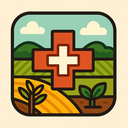
The icon presented is a powerful and intricately crafted visual synthesis that seamlessly merges three distinct yet profoundly interconnected themes: Agriculture, the Medical Cross, and Tribal heritage. Each element is not merely overlaid or juxtaposed but thoughtfully integrated into a single, cohesive emblem that speaks to the deep-rooted harmony between humanity’s primal connection to land, its enduring pursuit of health and wellness, and its rich cultural legacy. This icon stands as a symbol of holistic well-being—where food nourishes the body, medicine heals it, and ancestral traditions guide both processes.
At the core of the design lies a central Medical Cross, rendered in bold yet elegant lines. The cross is stylized with subtle angularity reminiscent of ancient tribal carvings rather than a modern clinical symbol. Its arms are slightly elongated and feature small, etched grooves that mimic the texture of carved wood or stone—elements commonly found in indigenous art. The central point where the arms meet is subtly enlarged into a circular node, suggesting unity and wholeness. This cross does not represent sterile hospitals or impersonal institutions; instead, it embodies healing as a sacred tradition, passed down through generations within tribal communities who have long relied on herbal remedies, spiritual ceremonies, and communal care to maintain health.
Encircling the medical cross are two intersecting arcs that represent Agriculture. The upper arc is composed of stylized golden wheat stalks, their heads bending slightly downward as if in reverence—a nod to the agricultural cycle of growth, harvest, and return. These wheat strands are not uniform but vary in length and texture, suggesting natural diversity and resilience. They curve gracefully around the cross like a protective halo or a traditional tribal headdress. The lower arc is made of deep green vines with broad leaves that twist and intertwine beneath the cross. Embedded within these vines are small, symbolic representations of root vegetables—potatoes, sweet potatoes, yams—highlighting not only staple crops but also their spiritual and nutritional significance to indigenous peoples who view farming as a sacred duty to the earth.
What truly elevates this icon is its Tribal aesthetic. The entire composition is etched with patterns derived from ancient tribal motifs found in African, Amazonian, Polynesian, and Native American art. Fine linework resembling body tattoos or ceremonial scarification decorates the background and outlines of both the wheat and vine elements. These patterns are not decorative fluff but carry deeper meaning: spirals represent life’s cyclical journey; zigzags symbolize lightning—the divine force that brings rain for crops; concentric circles embody community, continuity, and unity. The color palette reflects earth-toned symbolism—earthy reds, sun-baked ochres, forest greens, and deep indigo blues—all derived from natural pigments traditionally used in tribal rituals.
The integration of the Medical Cross within this agricultural and tribal framework transforms it into a symbol of indigenous medicine. It is not a European import or a sign of Western medical dominance but rather an emblem that suggests how traditional healers—shamans, herb doctors, and elders—have long combined their knowledge of medicinal plants (agriculture) with spiritual practices to restore balance and health. The cross becomes a bridge: one arm points upward toward the sky (spirit), another downward toward the soil (earth), while the other two stretch horizontally across life and community—the essence of tribal existence.
Furthermore, subtle details reinforce this fusion. At the base of each vine, tiny seed pods are carved with intricate symbols representing different healing plants—such as aloe vera, neem leaves, or echinacea. These seeds are not random; they suggest that medicine grows from the land and must be cultivated with care. Above the wheat stalks, small bird silhouettes—a dove and a hawk—are interlaced in flight—one symbolizing peace (healing), the other vision and insight (wisdom of elders).
When viewed as a whole, this icon transcends its individual components. It becomes a declaration that true health is not achieved through isolation or modernization alone, but through reconnection—reconnecting with the earth that feeds us, with ancient wisdom that guides our healing practices, and with the tribal values of community care and respect for nature. Whether used in public health campaigns targeting indigenous populations, wellness programs rooted in traditional knowledge, or eco-conscious agricultural cooperatives blending sustainability with healthcare access, this icon serves as a profound reminder: the roots of healing lie deep in soil, culture, and tradition.
In a world increasingly fragmented by technology and urbanization, this icon stands as both a call to remember and an invitation to return—to cultivate not just crops but compassion; to heal not just bodies but spirits; and to honor tribal wisdom as the foundation of sustainable well-being. It is more than an image—it is a story, etched in lines of earth, life, and legacy.
Create your own icon with our GoGPT AI prompt:
GoGPT