

Agriculture Moon Filled Free icon download
Download all to grab every PNG variant.
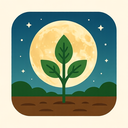
The icon under consideration is a masterful fusion of symbolic elements representing agriculture, the moon, and the aesthetic quality of being "filled," resulting in a deeply meaningful visual representation that speaks to both ancient traditions and modern design sensibilities. At its core, this icon embodies the harmonious relationship between nature’s cycles—particularly those governed by celestial bodies—and human stewardship of the land through farming and cultivation practices. The central theme is **agriculture**, symbolizing humanity’s enduring connection with the earth. In this icon, agricultural symbolism is not merely implied but actively expressed through a meticulously crafted depiction of a flourishing field or crop pattern. The design features stylized rows of wheat, barley, or rice stalks emanating from the base and gently curving upward toward the center of the composition. These lines are not rigid or mechanical; instead, they flow organically like waves on a tranquil field at dawn. Each stem is represented with subtle detail: faint veins to suggest life and growth, slight curvature to mimic how plants sway in natural wind currents. This attention to botanical accuracy elevates the icon from simple illustration into a sophisticated emblem of sustainable farming and rural heritage. Dominating the upper half of the icon is a **moon**, rendered in a full, luminous form that serves as both centerpiece and celestial guide. The moon’s shape is perfectly circular—an unbroken arc that fills the space with serene authority. Its surface is not flat but textured with gentle craters and low-lying terrain, creating subtle depth through soft gradients of silver, pale gray, and faint blue undertones. Rather than a cold or distant satellite, this moon appears benevolent: its glow radiates warmth rather than chill. The illumination suggests a full moon night when farmers historically conducted specific planting or harvesting rituals—times when lunar phases were believed to influence soil moisture and plant growth. What makes this icon truly distinctive is the **"filled"** aspect of its design. Every element—the crops, the moon, and even the surrounding space—is densely packed with visual information yet remains balanced and harmonious. Unlike minimalist icons that rely on negative space for clarity, this one embraces fullness as a virtue. The agricultural elements are not outlined or sparse; they are solidly rendered with thick lines and solid fills of warm earthy greens, golden yellows, and deep browns, suggesting abundance and richness. The moon is not a hollow circle with a border but an entirely filled disk, radiating light from within as if it contains its own inner starlight. This filled quality creates a powerful sense of presence. It transforms the icon into something tangible—almost sacred. The fullness suggests completeness: the harvest has been gathered, the cycle has been honored, and nature is in balance. There’s no emptiness here; instead, there is vitality. This design choice resonates with ancient agricultural cultures that revered fertility—not just of land but of life itself. The filled moon may also represent a symbolic womb of the world: a source of generative power where new growth begins. The integration between agriculture and moon is particularly poetic. In many traditional farming communities, the lunar calendar dictated planting schedules—planting during waxing moons for above-ground crops, harvesting during waning phases. This icon visually captures that spiritual connection by placing the full moon directly above the flourishing field, as if it is bestowing blessings upon the earth below. The light from the moon appears to pour downward in soft beams, illuminating each stalk with a gentle highlight that simulates moonlight filtering through a night sky. Color plays a crucial role in reinforcing these themes. The background is rendered in deep midnight blue, evoking the vastness of night, while the filled moon glows with internal luminosity—its white and silver hues slightly diffused to suggest atmosphere and distance. The crops beneath are richly saturated: not just green but varying shades that mimic different stages of growth—emerald for young shoots, gold for ripening grain, ochre for harvest-ready stems. This chromatic complexity adds depth without overwhelming the composition. Even the edges of the icon contribute to its filled aesthetic. There is no border or outline; instead, elements merge seamlessly into one another. The moon’s rays appear to flow into the field’s texture, blurring boundaries between sky and soil. This fluidity emphasizes unity—the idea that agriculture and celestial bodies are not separate domains but interconnected forces in a greater natural system. From a design standpoint, the icon is symmetrical yet dynamic. Its filled composition invites close inspection: each small detail—the way grass bends under moonlight, the slight variation in crop density—adds narrative depth. Yet it remains instantly recognizable at small sizes, thanks to strong contrast and bold shapes. In modern contexts, this icon could represent sustainable farming initiatives powered by lunar-aware practices, eco-friendly agriculture movements inspired by biodynamic principles, or even cultural celebrations of harvest festivals that honor the moon. It serves as a reminder that humanity’s relationship with the earth is not just about productivity but also about reverence—about aligning our actions with natural rhythms. Ultimately, this icon transcends its individual components. Through the harmonious blend of **agriculture**, **moon**, and the intentional use of a **filled** design language, it becomes a symbol of holistic balance: between human effort and nature’s cycles, between light and dark, between emptiness and abundance. It is not merely an image; it is a philosophy etched in form.
Create your own icon with our GoGPT AI prompt:
GoGPT