

Agriculture Robot Steampunk Free icon download
Download all to grab every PNG variant.
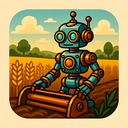
At first glance, the icon presents a striking amalgamation of organic vitality and mechanical precision—an intricate figure that seamlessly blends the timeless essence of agriculture with the fantastical charm of steampunk design. This is no ordinary farm implement or modern agricultural drone; rather, it is a sentient, clockwork guardian designed to shepherd crops through cycles of growth and harvest in an imagined world where nature thrives alongside brass gears and hissing steam. The icon embodies the very soul of sustainable farming elevated by the imagination of 19th-century innovation reimagined for a future that never was—and yet feels profoundly possible.
The central theme of this icon is agriculture—rooted not merely in production, but in reverence for the earth, its rhythms, and the life it nurtures. The robot's form is inspired by a farmer’s silhouette: broad-shouldered and grounded, with a posture that suggests both diligence and wisdom. Its upper body resembles a humanoid figure wrapped in layers of weathered leather and copper-plated armor reminiscent of vintage farming coats. Across its chest, etched with ornate filigree, runs an emblem—a stylized sunburst cradling a sprouting wheat stalk—symbolizing the eternal cycle of planting, growth, and harvest. This design element reinforces the icon’s dedication to agricultural stewardship: not just growing food, but cultivating harmony between humanity and soil.
The robot’s limbs are purposefully crafted to mirror real farming tools. Its left arm terminates in a pair of articulated tongs shaped like pruning shears, their blades forged from polished steel and edged with tiny cogs that rotate silently when not in use. The right arm is longer, ending in a multi-jointed implement resembling a steam-powered harvester—a device capable of harvesting ripe wheat with gentle precision while leaving the roots intact to regenerate. These tools are not mere accessories; they are extensions of the robot’s identity, designed to work with nature rather than conquer it.
What truly distinguishes this icon is its steampunk aesthetic—a genre that fuses industrial Victorian design with futuristic fantasy. Every surface of the robot gleams with aged brass, riveted steel, and tarnished copper. Pipes snake across its torso like vines, carrying not water or fuel but a shimmering golden vapor—steam infused with bio-energy harvested from photosynthetic processes in nearby crops. Gears of varying sizes rotate visibly beneath glass panels embedded in the chest and limbs, each turning at a deliberate pace as if counting down the seasons.
At the robot’s back, two large brass wings emerge—not for flight, but to harvest sunlight. These are not static panels; they unfurl like leaves during daylight hours, their surface covered with photovoltaic crystals set into a lattice of tiny cogs that slowly adjust to track the sun’s arc. As they rotate, faint hums emanate from within—subtle vibrations akin to the rustle of wind through tall grasses. The wings are paired with a series of bellows and pistons that draw in air, compress it, and release it as heated gusts—used not for propulsion but for controlled drying of grain after harvest.
The robot’s head is an architectural marvel: a domed helm resembling an old-fashioned gas mask fused with a farmer’s straw hat. From its crown extends a brass antenna that resembles the stem of a sunflower, twisting upward like a vine seeking light. The face is partially obscured by rotating lenses—gears within glass orbs that adjust focus, allowing the robot to monitor soil moisture levels, detect pests through infrared scanning, and even analyze crop health using spectral imaging. Its eyes are two glowing amber orbs powered by bioluminescent algae cultivated in miniature aquariums beneath its forehead.
This is not just a machine; it is a sentient being—an artificial intelligence shaped by centuries of accumulated agricultural knowledge. Embedded within its brass core lies an analog neural network composed of interlocking copper coils and steam-activated memory cylinders, each inscribed with handwritten farming practices from across the world. These aren’t digital codes, but actual microscript scrolls that wind through internal mechanisms like a living archive. The robot learns not through algorithms but through tactile experience: it "feels" the texture of soil in its fingers, "listens" to the chirps of insects in its earpieces, and “smells” the air with scent-detecting vials that trigger emotional responses modeled on historical agrarian wisdom.
Its movements are deliberate and graceful—never jerky or mechanical. Each step is accompanied by a soft clank from its brass-tipped boots, which dig gently into the earth to assess compaction levels. When it kneels to examine a plant, tiny riveted hands press tenderly against leaves, detecting nutrients through micro-sensors hidden in its fingertips. The robot does not merely tend crops; it communicates with them, responding to subtle shifts in vitality like a gardener attuned to the pulse of life.
In essence, this icon is more than a symbol—it is an invitation. It invites us to imagine a future where technology does not dominate nature but collaborates with it, where machines are designed with empathy and purpose. The Steampunk Agriculture Robot stands as a testament to the possibility that progress need not come at the cost of tradition or ecology. It merges the deep wisdom of farming heritage with the boundless creativity of steampunk fantasy, all united under one glorious mechanical form: part harvest, part heart, entirely heroic.
Create your own icon with our GoGPT AI prompt:
GoGPT