

Agriculture Satellite Classic Free icon download
Download all to grab every PNG variant.
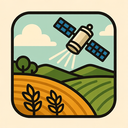
The icon in question is a masterful representation of three distinct yet harmoniously interwoven themes: agriculture, satellite technology, and classic design aesthetics. At first glance, it captures the imagination with its elegant simplicity and profound symbolism. This carefully crafted visual narrative blends ancient traditions of farming with cutting-edge space-based innovation—bridging millennia of human progress through a single emblem that honors both heritage and future. At the heart of the icon lies a stylized depiction of fertile farmland, rendered in earthy hues reminiscent of sun-baked soil, lush green crops, and golden wheat fields. The agricultural element is not merely decorative; it serves as the foundational theme. The field is segmented into perfect rectangular plots, evoking both precision farming and traditional terraced landscapes seen across centuries-old civilizations—from the rice paddies of Southeast Asia to the vineyards of Tuscany. These geometric divisions are not arbitrary; they symbolize order, planning, and sustainability—core principles in modern agriculture. Rising from this fertile base is a classic satellite orbiter, rendered in a vintage-inspired design that speaks to mid-20th-century space exploration. The satellite is composed of clean lines and symmetrical shapes—a circular body with three solar panels extending outward like delicate wings. Its surface bears subtle engravings that resemble the early models of orbiting instruments launched during the 1950s and '60s, evoking a nostalgic reverence for humanity's first steps into space. The color scheme is deliberately restrained: silver and chrome tones contrast with deep navy blue to convey both technological sophistication and timeless elegance. What makes this icon truly remarkable is the seamless integration of these seemingly disparate elements. The satellite does not hover aimlessly above the farmland; instead, it orbits precisely over a central field, its path forming a perfect elliptical arc that mimics real orbital mechanics. From the satellite’s underside extends a series of faint rays—resembling data signals or electromagnetic waves—that converge directly onto specific crop zones below. This detail is symbolic: it represents how satellite technology has transformed agriculture through precision monitoring, weather forecasting, soil analysis, and yield prediction. The design language throughout reflects a "classic" aesthetic—an intentional choice that elevates the icon beyond mere functionality. The lines are deliberate and balanced; the proportions adhere to golden ratio principles; the contrast between light and shadow is subtle yet dramatic. The absence of modern digital flourishes—no gradients, no neon effects, no pixelation—reinforces its timeless nature. Instead, it evokes traditional illustration techniques: hand-drawn precision with a touch of artisanal craftsmanship. The color palette further enhances the classic tone. Earthy browns and olive greens dominate the farmland; steel gray and gunmetal blue define the satellite. Accents of deep burgundy appear in subtle details—on one solar panel, perhaps—a nod to vintage design motifs from mid-century industrial art. The background is a soft off-white or parchment-like tone, suggesting an aged blueprint or technical drawing from a bygone era. This choice not only enhances visual clarity but also imbues the icon with historical gravitas. Every element of the icon has symbolic depth. The satellite, while representing modern technology, is designed to resemble instruments from NASA’s early missions—such as Explorer 1 or TIROS-1—thus connecting contemporary agricultural innovation with the pioneering spirit of space exploration. Its orbit isn't random; it follows a path that traces the movement of celestial bodies, subtly referencing how farmers have historically relied on stars for seasonal guidance. Meanwhile, the crops below are not generic. They are identifiable: wheat stalks with golden ears, rows of corn kernels in tight formation, and vine tendrils curling like living scripts across the field. These specific plant forms emphasize authenticity and realism—each detail meticulously rendered to reflect actual agricultural practices rather than abstract symbolism. The icon’s overall silhouette is instantly recognizable even at small sizes—whether displayed on a smartphone screen or printed on a poster. This universality is no accident; it reflects careful consideration of scalability and legibility, hallmarks of classic icon design principles first developed in the 19th century with railroad signage and early cartographic symbols. In essence, this icon stands as a visual manifesto of progress through integration: agriculture—the oldest human endeavor—empowered by satellite technology—the pinnacle of modern science—all framed within a timeless aesthetic. It speaks to the past not with nostalgia alone, but with reverence for enduring values: stewardship of the land, precision in planning, and the pursuit of knowledge beyond Earth’s atmosphere. More than just an image, this icon is a story—an elegy to tradition and a celebration of innovation. It reminds us that while tools evolve from wooden plows to orbiting satellites, our fundamental relationship with the soil remains unchanged. And in its classic form—balanced, harmonious, enduring—it offers hope: that progress need not abandon heritage; instead, it can honor it.
Create your own icon with our GoGPT AI prompt:
GoGPT