

Animals Bridge Thin Free icon download
Download all to grab every PNG variant.
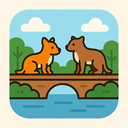
The icon under examination is a masterful synthesis of three distinct yet harmoniously intertwined concepts: **Animals**, **Bridge**, and the crucial attribute of **Thin**. At first glance, this minimalist symbol may appear deceptively simple—a slender line drawing on a neutral background—but upon closer inspection, it reveals layers of meaning that speak to ecological balance, human-animal relationships, and the delicate nature of connectivity in both natural and constructed environments. At its core, the icon depicts a **bridge**—a structure that inherently represents passage, transition, and connection. However, this bridge is not rendered in any conventional architectural style; instead, it is presented with an almost ethereal quality achieved through extreme minimalism. The bridge consists of just three or four precisely drawn lines: two vertical supports extending upward from the ground (or water surface), a horizontal beam connecting them at the top, and a single thin line running beneath to complete the arched or flat structure. What makes this representation particularly striking is its **thin**ness—each line in the bridge is so finely rendered that it appears almost imperceptible against a pale background, as if made of gossamer silk or moonlight. This deliberate choice of minimal thickness emphasizes fragility and transience, suggesting that connections are not always robust or permanent but rather delicate threads that require care and attention. The central narrative element emerges through the inclusion of **animals**. In this icon, a small group of animals—possibly deer, foxes, or even migratory birds—are depicted crossing the bridge in a single-file procession. These creatures are drawn with equal precision to the bridge itself: each animal is rendered as a silhouette composed of only two or three thin lines—no facial details, no fur texture, just essential outlines that capture movement and form. The animals are arranged symmetrically along the bridge’s length, creating a sense of rhythm and continuity. Their posture suggests cautious but determined progress; their heads slightly lowered as they navigate the narrow span. This visual storytelling technique implies not merely physical traversal but also an emotional or symbolic journey—perhaps migration, escape from danger, or a quest for survival. The integration of **Animals** and **Bridge** in a single composition is profoundly significant. Bridges are traditionally human-made structures designed for vehicles, pedestrians, or railways—but here, the bridge serves as a sanctuary and conduit for wildlife. This inversion of function speaks to modern ecological concerns: the increasing fragmentation of habitats due to urban development, highways, and industrial expansion. The icon becomes an allegory for conservation efforts—those that seek not only to preserve natural spaces but also to reconnect them through infrastructure designed with non-human species in mind. The presence of animals on a bridge symbolizes hope: that even within human-dominated landscapes, pathways can be created for nature to thrive. The **thinness** of the entire composition amplifies its message. A thin bridge implies vulnerability—what if it collapses? What if it’s too narrow for safety? These concerns mirror real-world environmental challenges where ecosystems are shrinking, migration routes are being severed, and biodiversity is declining. The icon’s minimalist aesthetic forces viewers to confront these issues with clarity and urgency. There's no ornamentation, no dramatic contrast or bold colors—just the delicate interplay of simple lines that invite contemplation rather than distraction. Furthermore, the use of thin lines contributes to a sense of timelessness and universality. Unlike icons with realistic textures or complex shading that anchor them in a specific moment or culture, this icon feels abstract and archetypal. It could represent any animal crossing any bridge at any point in history—from ancient times when animals crossed natural stone bridges to today’s wildlife overpasses built alongside highways in North America and Europe. The thinness also evokes the ephemeral nature of coexistence: the idea that harmony between humans, animals, and infrastructure is not guaranteed but must be consciously cultivated. From a design standpoint, the balance between **Animals**, **Bridge**, and **Thin** is meticulously maintained. No single element overwhelms the others. The bridge does not dominate; it serves as a framework for animal movement. The animals do not crowd the bridge; they are spread out in harmony with its form, respecting its narrowness as both a physical and metaphorical boundary. This equilibrium reflects an ideal ecological relationship—one where human infrastructure supports, rather than disrupts, natural patterns. In conclusion, this icon is far more than a visual shorthand for "animals on a bridge." It is a nuanced commentary on the delicate balance of modern life—where progress and nature must coexist through thoughtful design. The **thinness** of every line symbolizes the fragility of that balance: one misstep, one neglected habitat, one broken link in the chain can sever vital connections. Yet within that fragility lies beauty and resilience—the quiet determination of animals continuing their journey across a narrow span built by human hands, for all living things. It is a call to action wrapped in simplicity: protect the bridges we build—not just for ourselves, but for every creature who depends on them.
Create your own icon with our GoGPT AI prompt:
GoGPT