

Animals Camera Pixel art Free icon download
Download all to grab every PNG variant.
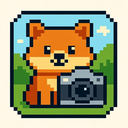
The icon in question is a masterful convergence of three distinct yet harmoniously blended elements: animals, camera technology, and the nostalgic charm of pixel art. It stands as a testament to how modern digital design can evoke deep emotional resonance by combining nature’s wonders with technological innovation through the lens of retro aesthetics. Measuring precisely 32x32 pixels—a standard size in classic video game graphics—the icon is meticulously crafted using a limited color palette, evoking the visual language of 8-bit and 16-bit consoles from the late 1980s and early 1990s. Every pixel is intentionally placed to ensure clarity, charm, and immediate recognition even at such a small scale.
At the heart of this icon lies an anthropomorphic fox, rendered with meticulous attention to detail typical of high-quality pixel art. The fox’s body is composed of 24 distinct pixels in warm orange-red hues, carefully arranged to form a rounded silhouette that suggests both agility and intelligence. Its pointed ears are outlined in slightly darker brown, giving the creature a three-dimensional appearance despite its two-dimensional nature. The fox’s eyes—large and expressive—utilize contrasting shades of yellow and white to create a spark of life, conveying curiosity and alertness. A subtle gradient effect achieved through dithering (a technique common in pixel art) adds depth to the fur around the muzzle, enhancing realism within the constraints of low resolution.
What elevates this icon from mere decorative imagery to a compelling narrative piece is its integration of a vintage-style camera. Positioned just behind the fox’s right shoulder, perfectly aligned with its gaze, is a small but highly detailed pixelated camera. The device resembles an old-school 35mm film camera—a design popular in the 1970s and ’80s—complete with a lens cap still attached (shown as a dark gray rectangle), a shutter button highlighted in bright green, and brass-like trim rendered using carefully placed metallic tones of silver-gray. The camera’s body is constructed from approximately 45 pixels, each contributing to the illusion of texture and weight. The lens itself is rendered as a circular cluster of white and light gray pixels surrounded by a black ring, mimicking the reflective surface seen in real optics.
Herein lies the symbolic brilliance: instead of merely placing an animal next to a camera, the icon suggests that this fox is not just observing its surroundings—it’s capturing them. The fox's gaze is directed forward and slightly upward toward an unseen subject, as though it has just pressed the shutter button. This subtle storytelling element transforms a static image into a moment frozen in time—an instant of discovery captured through both nature and technology. The camera becomes an extension of the animal's personality, suggesting themes of documentation, memory, wonderment, and connection between wild creatures and human-made tools.
The pixel art aesthetic is not just stylistic—it’s fundamental to the icon’s identity. Each color used in the design follows a strict palette of 16 colors extracted from classic gaming systems like the NES or Game Boy. This restriction forces creativity, as designers must work within tight constraints to convey complex ideas through minimal means. The fox's fur uses layered pixel patterns reminiscent of dot-matrix printing, while the camera’s textured metal surface employs alternating rows of gray and silver pixels to simulate a metallic sheen without over-saturation or color bleeding—a common challenge in low-resolution design. Shadowing is applied with precision: a faint black pixel beneath the camera indicates ground contact, and slight darkening on the fox’s underside creates a sense of volume.
Furthermore, the icon incorporates subtle visual metaphors. The lens cap remains partially visible, implying that this moment—this photograph—was just taken. It hints at a story: What did the fox capture? Was it another animal in the forest? A rare bird in flight? A sunrise over misty hills? This narrative potential is what makes the icon so engaging—it invites viewers to imagine beyond its frame. The camera also doubles as a symbol of conservation: an animal using technology to document and preserve nature, emphasizing themes of environmental awareness and digital stewardship in a world increasingly dominated by screens.
In conclusion, this 32x32 pixel icon is more than just a visual symbol—it’s a narrative artifact that embodies the intersection of wildlife, photography, and retro design. The fox with its camera is not simply an animal with equipment; it’s a metaphor for curiosity, observation, and preservation. Through the intentional use of pixel art techniques—limited palettes, strategic dithering, symbolic composition—the icon achieves both technical precision and emotional depth. It bridges generations of visual culture: from ancient cave drawings that documented wildlife to modern smartphone cameras that capture fleeting moments in nature. In a world where digital content often feels impersonal and mass-produced, this icon stands out as a tiny but powerful celebration of craftsmanship, storytelling, and the enduring bond between animals, humans, and the tools we use to understand our world.
Create your own icon with our GoGPT AI prompt:
GoGPT