

Animals Car Pixel art Free icon download
Download all to grab every PNG variant.
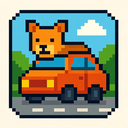
At the heart of this meticulously crafted pixel art icon lies a charming and whimsical scene that seamlessly blends three distinct yet harmoniously integrated elements: animals, cars, and the nostalgic charm of 8-bit video game aesthetics. This digital artwork is not merely an image but a narrative encapsulated in just 16x16 or 32x32 pixels—an artifact from a pixelated dreamscape where imagination meets retro simplicity. Every blocky detail serves a purpose, contributing to a vivid and instantly recognizable visual story that speaks directly to fans of classic video games, animal lovers, and enthusiasts of minimalist digital art.
The central figure in this icon is an anthropomorphic squirrel—a creature beloved for its agility, curiosity, and endearing appearance—reimagined with the precision of pixel art. The squirrel stands upright on two hind legs, embodying a playful sense of personhood while maintaining its natural features. Its eyes are large and expressive, crafted from just four pixels each: two bright white dots for the irises and one dark black pixel for the pupils, giving it a wide-eyed look of wonder or mischief. The squirrel’s fur is rendered in layered gradients using carefully chosen shades of brown and beige, mimicking the texture of real fur while adhering to the limitations of a limited color palette (typically 8–16 colors). A single bright orange pixel defines its bushy tail, which fans out slightly behind it as if caught mid-motion. This tail is not just decorative—it symbolizes energy, movement, and playfulness, essential qualities for the icon’s overall character.
What sets this icon apart is not just the animal—but how that animal interacts with a vehicle. Perched proudly on the squirrel’s back is a miniature, retro-style car—its design unmistakably inspired by 1970s concept vehicles and classic arcade game cars. The car is rendered in bold geometric shapes: a rounded hood, a flat roofline, and two distinct headlights that glow with bright yellow pixels. Its body uses muted pastel shades—a light blue base with white trim and red accent lines—creating a striking contrast against the natural tones of the squirrel. The wheels are simple yet effective: four small circular forms made of five pixels each (one central core surrounded by four outer rings), giving them a sense of motion even in static form. Tiny pixelated headlights flash with energy, suggesting that this car is not just decorative but functional—an essential mode of transport in this imaginative world.
The symbiotic relationship between the squirrel and the car is at the icon’s emotional core. It suggests a story: perhaps an adventurous woodland creature who has found or built a vehicle to explore beyond its forest home, or maybe a mechanic squirrel who repairs vintage cars in her underground garage. The pixel art style amplifies this narrative potential—the simplicity of each element allows viewers to project their own interpretations onto the image. In the absence of intricate facial expressions, we rely on body language: the squirrel’s raised tail and slightly tilted head imply confidence, curiosity, or even pride as it rides its tiny car through a pixelated landscape.
Background elements are minimal but meaningful. In true pixel art tradition, there is no clutter—only a few carefully placed pixels to suggest depth and context. A single green hill appears behind the squirrel-car duo (two horizontal rows of dark-green pixels), implying terrain beneath them. Two or three small pixelated trees—each built from four or five vertical brown stems topped with a cluster of six green dots—frame the scene on either side, grounding it in nature while emphasizing scale. A faint yellow line across the lower third represents a road, subtly guiding the eye and reinforcing that this is not just an animal adventure but a journey on wheels.
The color palette is deliberate and nostalgic: primarily composed of eight primary colors—black, white, dark gray, bright red, electric blue, sunflower yellow, forest green, and light orange—with no gradients or anti-aliasing. This adherence to the constraints of early pixel art (think NES or Game Boy) enhances authenticity. Every pixel is intentional; no stray marks or imperfections detract from the clean composition. The icon’s design respects the principles of minimalism and clarity—qualities essential in small-scale digital icons where detail must be instantly decipherable, even at a glance.
Ultimately, this pixel art icon transcends its basic components. It is a micro-story told through color, shape, and arrangement—a fusion of nature (animals), technology (car), and artistic tradition (pixel art). It speaks to gamers who grew up with 8-bit consoles, to children who delight in imaginative animals with modern twists, and to digital artists who value the beauty of constraint. In just a few dozen pixels, it captures wonder: the idea that even a small creature can dream big—driving through forests on tiny wheels powered by imagination alone.
This icon is more than decoration; it’s a celebration of creativity within boundaries. It reminds us that sometimes, the most powerful stories are told in the smallest spaces—with just one pixel at a time.
Create your own icon with our GoGPT AI prompt:
GoGPT