

Animals Drum Geometric Free icon download
Download all to grab every PNG variant.
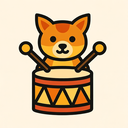
The icon in question is a striking representation of the interplay between nature, rhythm, and mathematical precision. At its core lies a powerful synthesis of three distinct yet harmoniously integrated elements: Animals, Drum, and Geometric. This intricate emblem transcends mere visual appeal; it functions as a symbolic narrative that captures the essence of primal energy, cultural expression, and structured elegance.
The central figure of the icon is a stylized animal—specifically, a lion or perhaps an anthropomorphic feline-like creature—rendered with both realism and abstraction. Its form is not fully literal but instead abstracted through geometric simplification, reflecting the fusion that defines this design. The lion’s head emerges from the upper portion of a circular drum surface, with its mane composed of interlocking polygonal shapes resembling jagged triangles and hexagons. This stylization transforms the natural texture of fur into angular patterns, suggesting strength, resilience, and ferocity through symmetry rather than fluidity.
The animal’s eyes are sharp and alert—large circles with smaller concentric rings inside each pupil—mirroring the precision of geometric composition while retaining a lifelike intensity. The snout is defined by a series of converging straight lines forming a trapezoidal shape, echoing the architectural structure of ancient temple facades. This deliberate merging of organic form and rigid geometry underscores the icon’s central theme: that natural life and human-made order are not opposites but complementary forces.
More than just an aesthetic choice, the inclusion of an animal—particularly a lion—serves as a powerful cultural symbol. In many traditions, lions represent courage, leadership, and spiritual guardianship. Here, the beast is not wild or untamed; it is contained within the structure of the drum and composed through geometric logic. This duality suggests that even the most primal instincts can be channeled into rhythm and order—just as a drummer harnesses raw energy into structured beats.
At the heart of this icon lies a drum, not merely as an instrument but as a sacred vessel—a cultural cornerstone across numerous civilizations. The drum’s body is shaped like a perfect circle, symbolizing unity and continuity. It is rendered in bold contrast with surrounding shapes: its surface is textured with radial lines that divide it into equal segments, creating the visual impression of tension and rhythm. These lines are not random; they follow a precise mathematical progression, resembling musical notation or wave patterns.
The drumhead is composed of a series of interlocking geometric patterns—circles within circles, pentagons nested inside hexagons—creating a tessellated effect that suggests both motion and stillness. This design echoes the concept of time: the drum produces sound in measured intervals, each beat a finite moment within an infinite cycle. The pattern on the drumhead subtly reflects this idea; it appears dynamic when viewed from afar but reveals its static, balanced structure upon closer inspection.
Surrounding the drum’s rim are small angular protrusions—like sharp spines or decorative flanges—each formed from equilateral triangles and right-angled polygons. These elements serve both functional and symbolic purposes: they suggest the physicality of a real drum (its tension rods, lugs, or hoops), while also reinforcing the geometric motif. Their arrangement follows a rotational symmetry of order seven—an uncommon number in design that adds an air of mystery and sophistication.
Most compellingly, one of the drum’s sides appears to be “playing” itself—the animal’s paw rests on the drumhead as if it were striking it. The clawed digits are modeled as sharp, elongated parallelograms, each aligned at precise angles. This detail blurs the line between instrument and performer: is the animal playing the drum—or is the drum manifesting through the animal? The ambiguity adds depth to the icon’s meaning: rhythm arises from nature and culture inextricably entwined.
Geometric forms are not merely decorative features in this icon—they are its foundational language. Every element, from the lion’s mane to the drum’s surface to the background patterns, is built upon principles of symmetry, proportion, and repetition. The overall composition adheres to a golden ratio framework: the dimensions of the drum align with Fibonacci sequences, while key components are positioned at points that reflect harmonic divisions.
Patterns throughout include tessellations—repeating shapes without gaps or overlaps—such as hexagonal grids and rhombic tiling. These not only create visual rhythm but also symbolize interconnectedness and infinite possibility. The background is filled with a faint, interlaced network of lines forming a grid-like lattice made of triangles and squares, suggesting the underlying order beneath chaos.
The use of negative space is particularly masterful. The silhouette of the lion’s form is defined not only by positive shapes but also by carefully calculated voids—areas where geometric precision creates the illusion of motion or depth. For example, gaps between polygonal mane segments are not random; they form a visual rhythm akin to drumbeats themselves, guiding the eye in a continuous loop around the icon.
This icon stands as more than an artistic creation—it is a metaphor. It embodies how Animals, with their instinctual power and emotional depth, can be harmonized through Drum, the universal language of rhythm and communication. And through the lens of Geometric design, we see that chaos can be transformed into structure, instinct into artistry. It speaks to humanity’s enduring quest to balance nature and reason, motion and stillness, emotion and logic.
In a world increasingly defined by digital abstraction and fragmented identities, this icon offers a timeless reminder: the most profound expressions arise not from one element alone—but from the convergence of them all.
Create your own icon with our GoGPT AI prompt:
GoGPT