

Animals Satellite Pixel art Free icon download
Download all to grab every PNG variant.
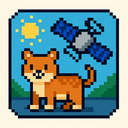
At first glance, this pixel art icon might appear to be a playful nod to classic video games from the 8-bit and 16-bit eras, but upon closer inspection—especially when considering its core themes of Animals, Satellite, and the intricate craftsmanship of Pixel Art—it reveals itself as a profound fusion of nature, technology, and artistic nostalgia. The icon measures precisely 32x32 pixels, adhering to the strict limitations that define true pixel art: every single square is purposeful, every color meticulously chosen from a restricted palette of 16 hues derived from the classic NES (Nintendo Entertainment System) color scheme. This small but densely layered composition tells a story far larger than its dimensions suggest.
At the center of the icon stands a stylized, anthropomorphic fox—its body composed entirely of geometric pixel blocks, yet imbued with an almost lifelike expression. The fox’s eyes are rendered in two bright yellow pixels, set slightly apart and angled upward with curiosity and intelligence. Its fur is a gradient pattern built from alternating shades of orange, red, and cream—each color block carefully positioned to suggest volume and texture without relying on anti-aliasing or soft edges. A single pixel at the top of its head marks the tip of an ear that curves slightly outward, while two more pixels form its delicate nose. The fox is depicted mid-stride as if it’s leaping toward something unseen—perhaps a distant celestial object—but its feet are not grounded in soil or grass; instead, they float above a digital landscape shaped by the icon’s satellite theme.
Below the fox, suspended in midair like an orb of technology wrapped in nature, is a stylized satellite. This is no ordinary space probe—its design blends retro-futurism with organic symmetry. The body of the satellite consists of a central hexagonal module made from six dark gray pixels, representing its primary structure. Radiating outward from this core are four solar panel arms, each constructed from five white and light gray pixels in a geometric starburst pattern that echoes both the motion of the fox and the rotational dynamics suggested by orbital mechanics. At each tip of these panels rests a small reflective pixel—representing either sensors or antennae—giving the satellite an air of quiet intelligence.
The true brilliance lies in how this satellite is visually connected to nature through a subtle, yet deliberate, design element: a thin, pulsating energy beam composed of animated gradient pixels that stretches from the satellite down to the fox’s back. This beam is not static—it appears as if it’s transmitting data or energy between the two entities. The color transitions through shades of cyan and soft blue in a rhythmic pattern across 3–4 frames within its animation loop, suggesting communication, symbiosis, and interdependence between wild animal life and human-made space technology.
Surrounding the entire composition is a circular boundary composed of eight alternating pixels—four green for grass-like terrain and four gray for what could be a digital ground. These pixels form an artificial ecosystem border that further emphasizes the icon’s central narrative: nature and technology coexisting, not in conflict, but in collaboration. In one corner of this circle, a small pixelated sun rises behind the satellite—a gentle yellow triangle with two orange highlights—adding warmth and implying that this is not a cold, mechanical world but one where life thrives even amidst digital skies.
What makes this icon particularly compelling is how it leverages the inherent strengths of pixel art. The low resolution forces clarity and symbolism: every pixel counts. There are no unnecessary details or decorative flourishes. The fox’s expression, for instance, conveys wonder and agency through just two colored pixels—its eyes—and a single curve of its muzzle. The satellite is recognizable as a spacecraft despite the minimalistic design because it adheres to iconic visual cues (solar panels, hexagonal core) that are instantly legible even at such small scale. This economy of form is central to pixel art philosophy: meaning emerges not from complexity but from precision.
Thematically, the icon speaks to a growing contemporary concern—the role of technology in monitoring and protecting our planet’s wildlife. The fox, as a symbol of wild nature and instinctual survival, is being observed—or perhaps even guided—by satellite technology. This duality captures the tension between surveillance and conservation. It suggests that while satellites may watch over Earth from above, they are not cold machines; rather, they are tools that can be allies to animals like the fox. The icon becomes a metaphor: through careful design and responsible innovation, we can use advanced systems not to dominate nature but to preserve it.
In conclusion, this 32x32 pixel artwork masterfully unites Animals, Satellite, and the artistic discipline of Pixel Art into a single, resonant image. It is more than just an icon—it is a digital fable. It reminds us that even in the smallest canvas, stories of connection, curiosity, and coexistence can be told with elegance and depth. Whether used as a game emblem for an environmental adventure title or as a symbol in open-source conservation software, this pixel masterpiece stands as both a tribute to retro aesthetics and a hopeful vision for our future.
Create your own icon with our GoGPT AI prompt:
GoGPT