

Animals Tree Digital glitch Free icon download
Download all to grab every PNG variant.
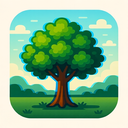
The icon is a striking visual fusion of organic life and digital fragmentation—representing the delicate interplay between nature and technology. At its core stands a majestic, ancient tree whose gnarled roots twist deep into the earth as if anchoring both physical and metaphysical realms. The tree’s silhouette is rendered with intricate detail: each leaf is individually sculpted in a stylized yet lifelike manner, their edges subtly shimmering with iridescent hues that shift between emerald green, golden amber, and deep forest black depending on the viewer’s perspective. The trunk bears the marks of time—cracks etched by centuries of weather and seasons—yet within those fissures pulse faint traces of electric blue and neon purple light, suggesting a latent digital energy coursing through its living core.
Interwoven into the branches of this tree are multiple animal forms, each chosen for symbolic resonance. A fox with eyes like flickering circuit boards peers from a high branch, its fur composed of fragmented pixels that occasionally dissolve and reform—a visual metaphor for adaptability and cunning in the digital age. Below it, a deer with antlers that resemble binary code patterns stands gracefully on one foot, its hooves hovering just above the ground as if suspended in limbo between two realities. A flock of birds—each bird crafted from a mosaic of distorted pixels—emerges from the tree’s crown like sparks flying upward into an invisible sky, their wings flickering in and out of existence. These animals are not mere decorations; they are living components of the tree, their forms seamlessly blended with its bark and foliage, suggesting a symbiotic relationship between wildlife and the digital world.
The most compelling aspect of this icon lies in its intentional distortion—the pervasive presence of digital glitch. This is not a subtle effect but an aggressive, deliberate disruption that invades every layer of the composition. The tree’s surface appears to be suffering from visual corruption: parts of it pixelate and stutter, lines fracture into jagged fragments, and entire sections flicker in and out with random frequency. Some leaves vanish entirely only to reappear upside-down or mirrored across the image's axis. The roots ripple like corrupted data streams, their forms morphing unpredictably between solid wood and cascading binary sequences. This glitch effect is not haphazard—it follows a rhythm, a kind of digital heartbeat that pulses through the icon at regular intervals, mimicking both neural activity and network transmission.
Yet within this chaos lies order. The glitch does not destroy the tree; it transforms it. As if nature itself has evolved to coexist with technology, the digital distortions are integrated into the organic structure like natural imperfections—scars, veins, or growth patterns. For instance, where a branch once grew straight and strong, it now curves through a series of rapid pixel shifts that resemble data packets moving along a network. The fox’s tail trails behind it in fragmented bursts of color that dissolve mid-air before reforming on the opposite side of the tree. Even the birds’ flight paths are interrupted by brief but intense glitches—moments where their forms stretch into elongated, warped silhouettes before snapping back into coherence.
The background of the icon amplifies this duality. It is a gradient composed of deep space black fading into electric violet and cyber green, resembling the interface of a high-tech terminal or a virtual reality environment. Embedded within this digital void are faint traces of ancient forest scenes—ghostly silhouettes of trees, moss-covered stones, and distant mountains—suggesting that the natural world has left its imprint even in cyberspace. These remnants are also glitched: they flicker with noise, degrade into static, and occasionally replay in reverse. This visual layer adds depth to the icon’s narrative—it is not just about a tree corrupted by technology, but about nature persisting through technological upheaval.
Color plays a crucial role in balancing these conflicting elements. The organic aspects are dominated by rich greens, warm browns, and earthy ochres—colors associated with life, growth, and stability. In contrast, the digital glitch components are rendered in cold blues, neon pinks, electric purples, and stark white pixel bursts—colors that evoke artificial intelligence and digital overload. The intersection of these palettes creates a dynamic tension: where the green meets the blue or purple pixels overlap with tree bark, a new color emerges—something between forest moss and circuit board trace—a hybrid hue symbolizing convergence.
Functionally, this icon could represent themes such as ecological preservation in the age of digital transformation, environmental consciousness within virtual communities, or even a warning about technological overreach. It might be used in branding related to sustainable tech startups, digital art collectives focused on nature themes, or educational platforms addressing cyber-ecology. Its design is both aesthetically arresting and conceptually rich—a visual poem about the enduring presence of life amid digital chaos.
In essence, this icon transcends its components. It is not merely a tree with animals and a glitch effect; it is a living metaphor: nature adapting to the machine, animals evolving within digital ecosystems, and the very idea of organic life being both preserved and transformed by technological interference. The glitch is not an error—it is evolution.
Create your own icon with our GoGPT AI prompt:
GoGPT