

Animals Tree Retro Free icon download
Download all to grab every PNG variant.
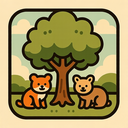
The icon presented is a masterful fusion of three distinct yet harmonious elements: Animals, Tree, and Retro. At first glance, this minimalist design captures the essence of nature’s enduring connection with wildlife while simultaneously evoking the warm nostalgia of mid-20th-century aesthetics. Every line, color choice, and compositional decision serves to weave together a narrative that speaks both to environmental harmony and cultural memory. At the center stands a stylized Tree—a towering figure with a broad canopy that seems to stretch upward toward an unseen sky. The trunk is rendered in bold, earthy brown lines with subtle texture mimicking bark grain, achieved through crosshatching techniques reminiscent of 1950s and 1960s graphic design. This tree is not merely a backdrop but the heart of the icon: its roots extend downward into a stylized soil layer composed of geometric patterns in ochre and burnt sienna, suggesting stability and deep connection to the ground. The canopy consists of overlapping circular shapes—some slightly flattened to give volume—painted in various shades of green, ranging from emerald to olive. These concentric rings suggest both the age and vitality of the tree, subtly symbolizing growth, timelessness, and resilience. What elevates this icon beyond a simple nature illustration is the integration of Animals that coexist peacefully within and around the tree. Two primary figures dominate the composition: a fox crouched near the base of the trunk, its red-orange fur rendered in vibrant yet slightly muted tones—a deliberate choice to align with vintage color palettes. The fox’s posture is alert but serene, one paw raised as if listening to a distant sound or simply observing its surroundings. Its eyes are large and expressive, rendered with a single dot for the pupil and a hint of white reflection—techniques common in retro cartoon illustrations from the 1960s. Above the fox, perched on a low branch, sits an owl. The bird is depicted in profile with its head turned slightly toward the viewer. Its feathers are simplified into layered shapes using block colors: deep gray for the back and wings, lighter beige for the underbelly, and distinctive black-and-white markings around its eyes—evoking a classic vintage cartoon style. The owl’s talons grip tightly onto the branch, adding a sense of grounded presence despite its elevated position. In true retro fashion, there is no attempt to render feathers in photorealistic detail; instead, the design embraces stylization and symbolic representation. Nestled within the tree’s canopy are two additional animals: a squirrel and a bird. The squirrel clutches an acorn with both paws and appears mid-leap from one branch to another, its bushy tail forming a dynamic arc that adds movement to the otherwise calm composition. The bird—small, with wings outstretched—is painted in warm amber hues against the green leaves, resembling the kind of stylized avian figures seen in 1950s children’s book illustrations or mid-century promotional art. The entire icon is framed by a circular border made up of a wavy line pattern that mimics a retro cassette tape edge—a clever nod to the audio technology era of the 1980s. This border not only defines the icon's shape but also reinforces its retro identity. Inside, at the top and bottom edges, are two thin bands of repeating geometric patterns: zigzags in navy blue and yellow, echoing mid-century modern design motifs often found in textiles, posters, and packaging from that era. Color palette is a defining feature of this retro-inspired icon. It relies on a limited but carefully selected range of hues: olive green, burnt umber, mustard yellow, sky blue for the background sky area (implied rather than shown), and rich maroon for accents. These colors were popular in vintage design due to their warmth and earthiness—colors that evoke memory and familiarity. The use of flat fills with minimal gradients reinforces the retro aesthetic associated with limited printing techniques (like screen printing) from past decades. Typography, though absent in the icon itself, is implied by its context: if accompanied by a label or logo, it would likely feature bold sans-serif letters with slight rounded corners—characteristic of 1970s design. This reinforces the overall nostalgic vibe without overshadowing the visual focus. The composition balances symmetry and asymmetry. While the tree stands centrally, creating a strong vertical axis, the placement of animals around it introduces organic imbalance—natural chaos that feels intentional and harmonious. This tension between order (tree as central pillar) and freedom (animals in motion) reflects both ecological balance and human longing for connection with nature. Ultimately, this icon is more than a visual symbol—it’s an emotional artifact. It speaks to a time when people felt deeply connected to the natural world, before urbanization accelerated; it reminds us of children’s books illustrated by artists like Errol Le Cain or Norman Rockwell (in his softer moments); and it celebrates the beauty found in simplicity. The Animals represent life, curiosity, and instinct; the Tree stands for continuity, shelter, and wisdom; while the Retro style acts as a time machine—inviting us to remember a simpler world where nature wasn’t just admired but deeply lived with. In an age of digital excess and environmental anxiety, this icon offers solace. It is a reminder: even in vintage form, nature’s message remains timeless.
Create your own icon with our GoGPT AI prompt:
GoGPT