

Art Credit card Glassy Free icon download
Download all to grab every PNG variant.
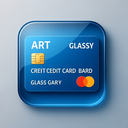
At first glance, the icon may appear as a simple representation of a credit card—a rectangular form with standardized dimensions and essential design elements such as the embossed card number and signature strip. However, upon closer examination, this seemingly mundane object transcends its utilitarian function to become an exquisite fusion of modern technology, financial utility, and refined artistic expression. This is not merely a digital representation of a plastic card; it is a masterful interpretation that harmoniously weaves together the themes of Art, Credit Card functionality, and Glassy aesthetics into a singular visual experience. The icon's central form—the credit card—serves as both its foundation and its narrative core. It adheres to the standard ISO/IEC 7810 ID-1 dimensions (85.60 mm × 53.98 mm), immediately signaling recognition and familiarity to users across cultures and digital platforms. Yet, rather than being rendered in a flat, monotonous manner typical of many transactional icons, this credit card is reimagined through the lens of high artistry. The surface is not matte or dull; instead, it gleams with a sophisticated glassy finish that reflects ambient light like polished crystal. This reflective quality transforms the icon from a static image into an interactive visual experience—one that shifts and changes depending on viewing angle and lighting conditions, mimicking the way real glass or mirrored surfaces behave. The glassy texture is not merely decorative—it conveys deeper symbolic meanings. Glass is often associated with transparency, clarity, and fragility—qualities that resonate powerfully with modern financial culture. In a world where trust in digital transactions hinges on transparency of data and security protocols, the glassy surface serves as a visual metaphor: the card’s inner workings (the information it carries) are visible yet protected. The shimmering finish suggests integrity and precision, while its subtle reflections evoke the idea of authenticity—something rare and valuable. Embedded within this glassy expanse is an intricate artistic composition that elevates the icon beyond mere functionality. The credit card's face features a meticulously designed geometric pattern resembling a contemporary art installation—a fusion of abstract lines, flowing curves, and negative space that suggest movement even in stillness. These elements are not randomly placed; they form a balanced symphony reminiscent of op-art or digital minimalism popularized by artists like Bridget Riley and Sol LeWitt. The patterns are rendered in translucent gradients—soft blues, silvers, and pearlescent whites—that seem to flow beneath the surface of the glassy material, giving the impression that light travels through a crystalline medium. The card’s logo is subtly integrated into this artistic framework. Rather than being a bold brand emblem, it is reinterpreted as an element within the overall design—a delicate monogram formed from interlocking glass-like filaments that seem to float within the surface. This approach emphasizes artistry over commercialism, reminding us that even in financial tools, beauty and creativity have a rightful place. The card’s edges are polished to a mirror finish, further enhancing the glassy effect. These sharp but smooth borders catch light with precision, casting tiny reflections that ripple across surrounding digital space. The thickness of the card is subtly implied through gradient depth—a technique often seen in 3D rendering and modern UI design—giving it a sense of physical presence despite its digital nature. Shadows beneath the card are faint and diffused, mimicking how real objects cast soft halos when viewed under ambient lighting, reinforcing the illusion that this is not just an image but a tangible artifact suspended in time. Even the credit card number is transformed into an artistic feature. Instead of being rendered in standard block numerals, it appears as a sequence of elegantly stylized digits etched with precision, their lines suggesting fine engraving on glass. The numbers are slightly translucent and glow faintly from within—like neon light trapped inside a transparent pane—adding another layer of visual intrigue. What makes this icon truly exceptional is how seamlessly all three elements—Art, Credit Card, and Glassy—are interwoven. Artistry informs the composition, structure, and symbolism; the credit card provides the functional anchor and narrative context; and the glassy quality unifies everything with its reflective elegance. It's a perfect example of how utilitarian design can evolve into high art when approached with intentionality, creativity, and technical mastery. In digital interfaces—from banking apps to e-commerce platforms—this icon serves not only as a navigation symbol but also as an aesthetic statement. It invites users to pause, appreciate detail, and recognize that even the most routine elements of modern life can be imbued with beauty. It challenges the notion that financial tools must be cold and clinical; instead, it asserts that innovation and elegance can coexist. Ultimately, this icon stands as a testament to the power of design: when art meets function, when technology embraces transparency, and when materials like glass become metaphors for trust and clarity. It is more than a digital representation—it is an invitation to see the world through a more refined lens—one where every transaction carries within it a whisper of beauty, craftsmanship, and artistic vision.
Create your own icon with our GoGPT AI prompt:
GoGPT