

Art Credit card Origami Free icon download
Download all to grab every PNG variant.
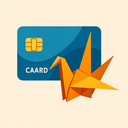
The icon presented is a masterful fusion of three seemingly disparate concepts—Art, Credit Card, and Origami—crafted into a single cohesive visual symbol that transcends traditional design boundaries. At first glance, the icon appears to be an elegant piece of modern origami art; however, upon closer inspection, it reveals intricate layers of meaning rooted in financial technology and human creativity. This icon is not merely decorative—it is a narrative device designed to encapsulate the intersection between innovation, expression, and digital commerce.
The central form of the icon resembles a stylized crane made entirely from folded paper—a classic symbol in origami that represents peace, longevity, and good fortune. Yet this crane is no ordinary creation. Its wings are delicately angled in a dynamic upward motion as if mid-flight, embodying the idea of aspiration and forward momentum. What sets this origami figure apart is its materiality: the paper used to craft it appears to be translucent with a subtle sheen, suggesting not traditional rice paper but rather a high-tech synthetic surface akin to that found on premium credit cards. The edges of the wings are slightly beveled, giving them a polished, almost metallic appearance under simulated lighting.
Upon further examination, the crane's body contains embedded details that reveal its identity as more than just an artistic sculpture—it is also a sophisticated representation of a modern credit card. Hidden within the folded paper structure are faint etchings resembling barcode patterns and microchip outlines. These elements are not merely decorative; they symbolize the digital infrastructure behind modern payment systems. The central core of the crane’s body doubles as a credit card’s chip—rendered here with precision using fine, geometric folds that mirror circuit board patterns. This subtle integration emphasizes that even in its most delicate artistic form, the icon acknowledges its connection to financial technology.
The color scheme of the icon is deliberately balanced between warmth and modernity. The base hue of the origami crane is a soft ivory with a faint gold undertone, reminiscent of aged parchment or high-quality banknote paper. This gives it an aura of authenticity and tradition—qualities often associated with classical art forms like origami. Overlaid on this foundation are gradients of deep navy blue and silver, echoing the colors found on premium credit cards from international financial institutions. These hues add a sense of security, trust, and technological sophistication to the design.
What elevates this icon into a work of conceptual art is its symbolism. The crane—traditionally associated with Japanese culture and spiritual beliefs—becomes a metaphor for economic mobility and personal empowerment. In ancient tales, origami cranes are said to grant wishes when folded in perfect symmetry, often by people seeking healing or transformation. Here, the crane symbolizes the aspirational nature of financial independence: just as folding a crane requires patience, precision, and intentionality—so too does managing personal finance effectively.
Moreover, the act of folding paper into a credit card shape transforms an everyday object into something deeply artistic. This visual metaphor suggests that behind every transaction lies a story—an intention, a decision, an emotional investment. The icon challenges the viewer to reconsider what constitutes "art" in the digital age: is it only found in museums and galleries? Or can it also be embedded within the tools we use daily for commerce and self-expression?
From a design standpoint, every fold of this origami credit card has been calculated. The wings are not symmetrical but slightly asymmetrical—reflecting the imperfections that make handcrafted art unique. This intentional deviation from perfect symmetry reinforces the idea that true art is never sterile or mass-produced. Even though the icon draws inspiration from a standardized financial instrument, it resists uniformity through its hand-touched aesthetic.
On digital platforms, this icon behaves dynamically: when hovered over or tapped (on touch devices), it subtly animates—the crane’s wings flutter slightly as if alive, and a faint glow emanates from the credit card chip at its core. This motion reinforces the idea that art and finance are not static concepts but living systems capable of evolution and interaction.
In conclusion, this icon is a profound synthesis of three powerful ideas. It honors the ancient tradition of origami as a form of meditative art; it acknowledges the central role credit cards play in modern economic life; and it asserts that even functional objects can become vessels for creativity and meaning. By merging these elements into one harmonious symbol, the icon becomes more than a visual identifier—it becomes a statement about how art, finance, and craftsmanship are not opposing forces but deeply interconnected aspects of human progress.
It is an invitation to see the world differently: where every transaction can be an act of creation, and every piece of paper—whether folded into a crane or printed with financial data—carries the potential for beauty and purpose.
Create your own icon with our GoGPT AI prompt:
GoGPT