

Art House Retro Free icon download
Download all to grab every PNG variant.
Imagine an icon that transcends mere visual representation—something that encapsulates a feeling, a memory, and a cultural epoch. The icon in question is not just an image; it is a portal into the 1970s psychedelic era fused with the timeless warmth of domesticity and the boundless creativity of artistic expression. At its core lies the harmonious convergence of three powerful themes: Art, House, and Retro. Each element is meticulously interwoven to create a symbol that feels simultaneously nostalgic and freshly relevant.
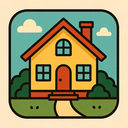
The icon’s primary shape is a stylized house—simple yet evocative. It resembles an abstracted single-story cottage with a steeply pitched roof, reminiscent of the mid-century modern architecture popular in suburban neighborhoods across America during the 1960s and 70s. The structure is drawn with clean, geometric lines but softened at the edges to give it a hand-drawn, almost whimsical quality. This duality—between precision and playfulness—is central to its identity. The house is not just a building; it’s a sanctuary, a haven for imagination and self-expression.
But this house is no ordinary dwelling—it has been transformed by art. The roof is tiled with vibrant, swirling patterns in the style of Art Nouveau meets psychedelic wallpaper from the 1970s. Colors bleed into one another: electric turquoise merges with burnt orange, deep lavender dissolves into sunshine yellow, and gold leaf accents shimmer like sunlight on a dusty vinyl record. These patterns are not random; they form flowing, organic shapes—curving vines, blooming flowers that double as eyes or musical notes—and suggest motion and rhythm. The windows are large panes of stained glass painted in abstract designs: concentric circles reminiscent of Rorschach ink blots, kaleidoscopic mandalas, and fractured geometric forms inspired by the work of M.C. Escher.
The front door is a canvas unto itself—a bold red portal with a circular brass doorknob that glows faintly as if lit from within. On the door’s surface, intricate line art depicts surreal scenes: floating books, dancing silhouettes, and miniature landscapes growing out of teacups. These images are rendered in fine detail yet retain a childlike charm—much like illustrations from vintage children’s books or underground comic magazines of the 1970s. A small wooden sign above the door reads “Art House” in a hand-lettered font that mimics retro 1970s typography—rounded, slightly wobbly, with an aura of carefree creativity.
Surrounding the house is an imaginative landscape that further amplifies its retro-artistic character. A small garden spills out from beneath the porch, filled with oversized flowers drawn in a surreal style: daisies with eyes for centers, tulips shaped like trumpets, and sunflowers whose faces turn to follow the viewer. The lawn is not green but a patchwork of mosaic tiles—each tile inscribed with tiny artistic symbols: paintbrushes, musical notes, film reels, and open books. This garden exists in a dreamlike state where nature and culture merge into one harmonious whole.
A pathway leads up to the house made of broken record grooves that curl like vines. Each groove is etched with faint music notation from classic jazz standards or psychedelic rock anthems—songs by The Beatles, Pink Floyd, Jimi Hendrix, and Joni Mitchell. As the eye traces the path upward, it becomes clear that this is not just a house—it’s a listening room for memories and muses. Above the roof floats a stylized record player turntable with floating vinyl records spinning slowly in midair like planets in orbit. The needle glows faintly, as if still playing an eternal track.
The color palette is deeply rooted in retro design—warm earth tones (mustard yellow, terracotta red) clash beautifully with bold primaries and neon pastels. Yet, the overall impression is not garish but rich and layered. There’s a sense of depth and texture: brushed metal effects on the doorknob, textured gradients simulating vintage paper or fabric, and subtle halftone patterns mimicking old magazine printing techniques. These design choices evoke not only the visual language of mid-century design but also the tactile pleasure associated with physical media—vinyl records, hand-bound sketchbooks, retro ceramics.
What makes this icon truly special is its emotional resonance. It speaks to a time when art was not confined to galleries or museums but lived in homes, shared among friends at parties, written in diary margins, painted on walls. The “House” becomes the metaphor for creativity—where inspiration flourishes and where artistic expression is welcomed as part of daily life. The “Art” element is not just decoration; it’s a way of being. And the “Retro” aspect does not mean outdated—it means timeless, deeply human, and full of soul.
In digital interfaces, this icon would serve as a symbol for creative studios, artist collectives, vintage design firms, or even personal journals and home-based workshops. It invites users to pause—reflect—and remember that the most profound art often begins in quiet spaces: within a house shaped by imagination.
Ultimately, this icon is more than pixels on a screen. It’s an homage to the idea that home can be an artwork, and art can be a home—a perfect fusion of identity, memory, and beauty from decades past that continues to inspire today.
Create your own icon with our GoGPT AI prompt:
GoGPT