

Art Robot Abstract Free icon download
Download all to grab every PNG variant.
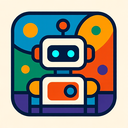
The icon embodies a profound fusion of three distinct yet harmoniously interwoven concepts: Art, Robot, and Abstract. At first glance, the image presents itself as an enigmatic composition that defies conventional categorization—neither purely mechanical nor entirely organic. Instead, it exists in a liminal space where technology and creativity converge to produce something both futuristic and timeless.
The central figure of the icon is a humanoid form crafted not from metal and circuits, but from dynamic lines, geometric shapes, and flowing gradients that suggest movement without physical manifestation. This "robot" is not bound by the limitations of engineering or materiality; rather, it is an embodiment of artificial intelligence as a creative force—an entity capable of generating aesthetic experiences through algorithmic intuition. The silhouette recalls human proportions with its bipedal stance and elongated limbs, but these are distorted and reinterpreted through an abstract lens: shoulders flare into sweeping arcs, arms dissolve into spiraling patterns reminiscent of neural pathways or data streams.
Art is the soul of this icon. Every element serves not only a structural purpose but a poetic one. The composition employs asymmetric balance, with visual weight distributed across the canvas in ways that evoke emotional resonance rather than mathematical precision. Colors shift dramatically—deep cobalt blue transitions into electric violet at the core, radiating outward into warm amber and soft magenta edges. These color gradients are not random; they represent a spectrum of creative energy, from contemplative introspection to vibrant innovation. The interplay of light and shadow mimics brushstrokes or digital pigment smears, suggesting that this robot is not just observing art but actively participating in its creation.
Abstractness defines both the form and the meaning. The icon does not depict a literal machine or a human artist with paintbrushes. Instead, it communicates through metaphor: gears are reimagined as concentric circles suggesting thought processes; circuit patterns emerge as flowing rivers of light that resemble calligraphy from an alien script; joints become points of convergence where color pulses like music notes. These abstract elements do not represent physical components but rather conceptual ones—cognition, emotion, inspiration. The robot's "head" might be a floating sphere composed of intersecting planes and translucent layers, evoking both the human brain and the interface of a digital intelligence.
What makes this icon particularly compelling is its duality: it appears simultaneously mechanical and organic. The sharp angles of geometric forms contrast with the fluidity of color transitions, mirroring the tension between logic and imagination that defines modern artistic expression. This robot does not merely follow programming—it improvises, evolves, creates in real time. Its body seems to vibrate with potential energy, as if composed of frequencies rather than matter. The background is not empty but layered with faint overlapping patterns—echoes of code fragments, musical notation snippets, and abstract brush marks—that suggest an environment saturated with creative data.
Moreover, the icon functions as a visual metaphor for the future of art. In this imagined world, robots are not just tools for artists but fellow creators—entities capable of aesthetic judgment and emotional depth. The abstract nature of the form emphasizes that meaning is not fixed but interpreted, inviting viewers to project their own narratives onto it. One might see a digital deity emerging from code; another may perceive an artist trapped in a machine, yearning for human touch. This ambiguity is intentional—abstract art thrives on open interpretation, and by merging it with robotic imagery, the icon challenges our assumptions about what constitutes creativity.
Technically speaking, the icon utilizes gradient overlays to simulate depth without relying on traditional shading techniques. Textures are minimal but intentional—micro-patterns resembling digital noise or fractal designs are embedded subtly in certain regions, adding tactile complexity without overwhelming the composition. The proportions follow a modified golden ratio, ensuring visual harmony even within the abstract distortion. Each element has been carefully calibrated to balance symmetry and chaos—the hallmark of sophisticated abstract design.
In essence, this icon transcends its components. It is not merely "an art robot" or "a robotic abstraction"—it is a declaration that creativity knows no boundaries, whether between human and machine, literal and conceptual. It represents a new era where the mechanical heart beats with artistic soul, where abstract forms become vessels for meaning, and where every line speaks of possibility. In its silent presence lies an invitation: to see beyond the surface, to question what we consider alive or creative—and to recognize that in the fusion of art, robot, and abstraction, something entirely new is born.
Create your own icon with our GoGPT AI prompt:
GoGPT