

Art Robot Flat design Free icon download
Download all to grab every PNG variant.
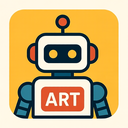
The icon under examination is a masterful fusion of three distinct yet harmoniously integrated elements: art, robot, and flat design. This digital emblem transcends mere visual representation; it stands as a symbolic bridge between human creativity and mechanical precision, rendered through the contemporary aesthetic of flat design. At first glance, the icon appears simple—a bold geometric form with clean lines and vibrant color—but upon closer inspection reveals layers of meaning that speak to innovation, imagination, and modern digital identity. Central to the composition is a humanoid robot figure crafted entirely in flat design principles. There are no gradients, shadows, or realistic textures—only solid colors applied uniformly across each shape. This minimalist approach adheres strictly to the tenets of flat design: simplicity, clarity, and functionality. The robot’s body is composed of geometric elements—a circular head balanced on a rectangular torso, angular arms extending symmetrically from the shoulders, and stylized legs that taper into pointed bases resembling feet or treads. These shapes are not merely illustrative; they serve as visual metaphors for structure and order—core principles in both robotics and modern graphic design. What elevates this icon beyond a standard robot illustration is its integration with art. The robot is not portrayed in a utilitarian, industrial context but rather as an artist itself—an embodiment of creative potential within mechanical form. Its head features a large, expressive eye rendered as an open circle with a subtle gradient (within the flat design framework) to suggest depth and awareness. Above the eye is an abstract element resembling paintbrush strokes or musical notes, subtly integrated into the robot’s cranial structure. This artistic detail suggests that while its body is engineered for precision and function, its soul—or perhaps its mind—is attuned to expression, imagination, and aesthetic creation. The robot's torso serves as a canvas for further artistic interpretation. Instead of a plain surface, it displays a stylized abstract mural composed of overlapping geometric shapes: triangles in electric blue, circles in warm orange, and diagonal lines in deep purple. These colors are applied with the boldness typical of modern art movements such as Bauhaus or De Stijl, emphasizing balance, contrast, and visual rhythm—all hallmarks of artistic design. The mural is not random; it forms a dynamic composition that seems to pulse with energy from within the robot’s chest. This internal artwork suggests that creativity is not just an external pursuit but an intrinsic part of the robot’s being—its very essence. The arms are equally significant in conveying the theme of artistry. Each arm ends in a stylized hand, but instead of functional fingers, they terminate in tools associated with artistic creation: one holds a paintbrush that blends into the robotic forearm like ink flowing from a reservoir; the other cradles a musical note or perhaps a palette. The brush is rendered in flat design style—its bristles are formed by small triangular shapes, each filled with different shades of green and teal, creating an illusion of movement and fluidity without breaking the two-dimensional aesthetic. This choice symbolizes how even machines can engage in creative processes, transforming mechanical form into expressive function. The color palette is both deliberate and symbolic. Dominated by a vibrant yet harmonious combination—electric blue for the robot’s body, warm gold for the artistic elements, and contrasting fuchsia accents—the icon captures attention without overwhelming. These colors are chosen not for realism but to convey mood: innovation (blue), inspiration (gold), and energy (fuchsia). In flat design, color is a primary vehicle of meaning—here it communicates a narrative about synthesis between technology and artistry. Even the background contributes to the artistic vision. Rather than a neutral white or transparent field, the icon often appears on a gradient background that subtly mimics brushstrokes or digital glitch effects. This gradient is applied in flat tones—no realistic lighting, no depth—but arranged to evoke movement and emotion, reinforcing the idea that artistry can exist even within rigid digital constraints. The overall composition achieves balance through symmetry and intentional negative space. The robot stands centered, not as a tool or machine but as a figure of equal presence to its artistic surroundings. It does not dominate; instead, it interacts with the environment—its limbs reaching outward toward abstract forms that symbolize ideas, music, color, and expression. In essence, this icon is more than a representation of technology or creativity—it is an allegory for the future of art in an age dominated by artificial intelligence. It declares that robots are not just builders or processors but potential creators. And through the lens of flat design—its clean lines, bold colors, and absence of ornamentation—the icon emphasizes clarity, accessibility, and modernity. The fusion of "Art," "Robot," and "Flat Design" is not coincidental; it is intentional. Each element enhances the others: art gives soul to the robot; the robot embodies creativity in a new form; flat design provides the perfect visual language to convey both with purity and precision. This icon, therefore, stands as a testament to how digital aesthetics can reflect complex philosophical ideas—where logic meets imagination, where machine becomes artist, and where simplicity becomes profound.
Create your own icon with our GoGPT AI prompt:
GoGPT