

Communication Airplane 3D isometric – Free icon download
Download all to grab every PNG variant.
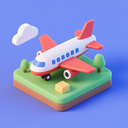
In today’s increasingly interconnected world, communication has evolved beyond simple text or voice into a complex network of digital signals that span continents and time zones. At the heart of this transformation lies the modern airplane—no longer just a vehicle for physical travel, but a powerful symbol of global connectivity. This icon, thoughtfully designed to reflect the intersection of Communication, Airplane, and 3D isometric aesthetics, embodies the seamless fusion between technological advancement and human interaction across distances. It serves not only as a visual representation but as a conceptual bridge between physical movement and digital exchange.
The icon begins with its foundational structure: a stylized 3D isometric perspective. This design choice provides depth, realism, and spatial awareness in a way that traditional flat icons cannot achieve. The isometric projection uses three axes—x, y, and z—to create a visually balanced view where all sides of the object are visible at equal angles. In this context, the airplane is rendered in precise geometric lines that maintain symmetry while suggesting movement through dynamic angles. The use of 3D isometric not only enhances visual appeal but also conveys a sense of scale and dimensionality, making it easy for users to instantly recognize the object’s volume and spatial presence.
At the core of this icon is an elegant airplane shape, drawn with clean, sharp edges to emphasize clarity and functionality. The fuselage is rendered with subtle gradients—transitioning from light blue at the front to a darker tone near the tail—to suggest both modernity and technological sophistication. The wings are slightly angled forward, indicating flight in motion. Instead of being a simple aircraft silhouette, this airplane integrates elements of communication infrastructure directly into its design. For instance, visible along the fuselage and extending from the wingtips are subtle wave-like lines that resemble data streams or signal transmissions—visual metaphors for digital communication.
Crucially, this is not merely an airplane icon with a label; it is a Communication-focused design. The signals radiating from the aircraft are not random—they follow logical pathways that mimic how information travels through airwaves and satellite networks. These signals form interconnected nodes or loops, suggesting both real-time data transfer and networked communication systems such as mobile broadband, voice over IP (VoIP), or satellite telephony. Each signal line is subtly curved to reflect the natural flow of digital data through space, giving the impression of a living communication ecosystem rather than static information.
The integration of Communication into the airplane’s design goes beyond surface-level decoration. The cockpit area features small, glowing dots or circular icons representing active calls or messages—visual cues that align with user expectations in digital interfaces. These elements are carefully positioned to suggest interaction, allowing users to interpret the icon as both a communication tool and a platform for real-time engagement. In addition, faint lines resembling radio waves emanate from the plane’s tail, reinforcing its role as a transmitter and receiver within global networks.
From an aesthetic standpoint, the 3D isometric style gives this icon exceptional versatility across digital platforms. Whether displayed on a smartphone interface, a dashboard in a corporate app, or embedded within a network management system, the icon retains readability and impact due to its depth and three-dimensional structure. The isometric layout avoids visual clutter while maintaining clarity—making it ideal for use in user interfaces where space is limited but information must be conveyed efficiently.
Furthermore, the 3D isometric approach fosters a sense of realism and trust. Users are more likely to perceive such icons as authentic and professional because they appear grounded in physical reality, even when depicting abstract concepts like data transmission. The depth cues—such as overlapping planes, foreshortening, and perspective—are subtle yet effective in guiding the viewer’s eye through the composition from the fuselage outward to the signal networks.
Designers have also leveraged color psychology to enhance user understanding. The primary color palette includes a cool blue tone for both the airplane body and signal lines—colors associated with technology, trust, and clarity. This choice aligns with branding standards in communication tools such as messaging apps or cloud services. Accent colors, like soft green or neon cyan, are used sparingly to denote active connections or incoming data, adding dynamic energy without overwhelming the composition.
Functionally speaking, this icon can serve multiple purposes depending on context. In a mobile app interface, it might represent a user’s airplane mode status—indicating that data transmission is either disabled or active. In a business communication dashboard, it could symbolize global reach and real-time coordination across international teams. Even in educational materials about aviation and technology, this icon provides a visual anchor for discussing how modern aircraft contribute to global communication infrastructure.
Moreover, the combination of Airplane, Communication, and 3D isometric design principles makes this icon highly adaptable. It can be scaled down for mobile screens or expanded for use in large infographics without losing its integrity. Its modular nature allows designers to add or remove elements—such as signal strength indicators or time-of-flight markers—based on application needs.
In conclusion, the "Communication, Airplane, 3D Isometric" icon is far more than a simple visual motif. It is a thoughtfully constructed symbol that reflects the evolving relationship between physical travel and digital connectivity. By merging realistic architectural form with dynamic communication elements within a depth-rich 3D isometric framework, this icon becomes both intuitive and powerful—offering users an immediate understanding of global information exchange through the movement of an airplane. As technology continues to blur the lines between physical space and virtual networks, this design stands as a compelling visual representation of our increasingly connected world.
Create your own icon with our GoGPT AI prompt:
GoGPT