

Communication Bank Retro – Free icon download
Download all to grab every PNG variant.
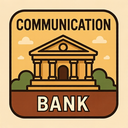
In a rapidly evolving digital age where information flows at lightning speed, the concept of a "Retro Communication Bank Icon" emerges not just as an aesthetic choice but as a thoughtful synthesis of historical design principles, financial trust, and human connection. This icon is more than a visual symbol—it is a narrative that bridges time, function, and emotion. At its core lies the convergence of three essential elements: Communication, Bank, and Retro. Each of these components contributes not only to the icon’s identity but also to its deeper cultural significance.
The "Retro" aspect serves as the foundational tone of this icon. Drawing from 1970s and 1980s design aesthetics—think pixelated grids, monochrome palettes, vintage typography, and analog textures—the retro influence infuses the icon with a sense of nostalgia and authenticity. It evokes a time when communication was slower but more deliberate, when banks operated through physical branches with handwritten ledgers and face-to-face transactions. This aesthetic choice is not merely decorative; it signals reliability and tradition—a visual language that speaks to users who value familiarity, stability, and human touch in technology.The "Bank" element grounds the icon in a world of trust, security, and financial responsibility. The icon features stylized elements such as a vault-like structure with a circular keyhole design resembling an old bank teller’s drawer or a vintage cash register with visible dials. These motifs are rendered in clean lines reminiscent of 1970s signage—bold geometric shapes, sharp corners, and high contrast between light and dark tones. The presence of currency symbols (like a stylized dollar sign composed of retro-style dots and curves) subtly reinforces the financial identity. The icon suggests safety, protection of value, and the integrity that users expect when managing money through digital or physical platforms.
Yet, within this traditional framework lies a powerful emphasis on Communication. This is not just a symbol of financial institutions—it is a bridge between people. The retro design includes subtle elements such as wave-like lines resembling old telegraph signals or early telephone wires that weave through the structure of the bank vault. These lines form interconnected patterns, suggesting both data flow and human interaction. In one corner, a small pixelated chat bubble with an old-school dial tone is embedded—evoking the sounds and rhythms of past communication methods like rotary phones or fax machines. This speaks to how communication once served as a slow but personal exchange between individuals and institutions.
What makes this icon truly unique is its ability to merge these three aspects into a cohesive, emotionally resonant image. The retro design does not diminish the modern relevance of banking—it enhances it by reminding users that behind every transaction, every transfer, every message sent from a bank account lies a history of human interaction. In an era dominated by AI-driven chatbots and algorithmic financial tools, this icon stands as a gentle counterpoint: it calls attention to the warmth of connection, the importance of trust in financial relationships, and the value of remembering how we once communicated with banks through real people.
From a user experience standpoint, this icon is designed for accessibility across generations. The retro style appeals to older users who may feel more comfortable with familiar designs, while younger audiences recognize its nostalgic charm as a form of visual storytelling. It functions well in mobile applications and financial dashboards where clarity and emotional tone are equally important. The simplicity of the design—clear shapes, minimal clutter—ensures it is instantly recognizable even on small screens or low-resolution displays.
Functionally, the icon could represent various services: secure messaging between account holders, notifications about account updates via old-school-style alerts (like a chime or dial tone), or even digital banking platforms that prioritize transparency and community engagement. The retro elements serve as visual metaphors—each line in the icon suggests a pathway of communication, each curve symbolizes trust and flow. The bank vault is not just a container; it’s a meeting point between the user and their financial identity.
Moreover, this icon can be interpreted as an embodiment of cultural memory. It reflects how financial systems were once built on personal relationships—between customers and bankers, between families and their accounts. In today’s world where digital transactions are impersonal, the retro communication bank icon acts as a tribute to those foundational human connections. It reminds users that behind every balance sheet or transfer is a story: of savings, dreams, emergencies, and shared experiences.
In conclusion, the Retro Communication Bank Icon is not simply a visual representation—it is a symbolic bridge between past and present. It honors the heritage of physical banks through retro design while integrating modern communication needs through intuitive visual language. By combining Communication (the exchange of information and trust), Bank (security, value, financial stewardship), and Retro (nostalgia, authenticity, human touch), this icon creates a powerful emotional resonance. It speaks to the universal desire for connection in both our personal lives and our financial transactions. In an age where speed often replaces depth, this icon reminds us that trust is built not through algorithms alone, but through shared history and human understanding.
Create your own icon with our GoGPT AI prompt:
GoGPT