

Communication Bridge Origami – Free icon download
Download all to grab every PNG variant.
At the heart of human progress lies the art and science of Communication. It is not merely the transfer of words or messages, but a dynamic exchange rooted in empathy, understanding, and shared meaning. In today's increasingly interconnected world—where information flows across borders and cultures—the need for effective communication transcends language barriers and technological platforms. This icon embodies that essence through a delicate yet powerful fusion of three symbolic elements: Communication, Bridge, and Origami. Together, they form a visual metaphor for the profound human desire to connect, to build understanding, and to transform simple ideas into enduring relationships.
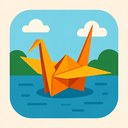
The icon centers on a meticulously crafted origami crane, suspended in mid-air with elegant folds that appear both precise and fluid. This crane is not simply a traditional symbol of peace or hope; it is an architectural marvel of form and function. Each fold represents a layer of communication—each crease holding the memory of interaction, negotiation, and mutual respect. The process of origami itself mirrors the journey from chaos to order, from unstructured thought to meaningful expression. In this context, Origami becomes not just an art form but a philosophy: it teaches patience, intentionality, and the belief that complex forms can emerge from simple beginnings.
As the crane hovers above a central point of convergence—visible as a subtle shimmering platform or nexus—the icon reveals its core function as a Bridge. This bridge is not made of stone or steel, but of paper and possibility. It spans gaps between cultures, generations, individuals, and even opposing viewpoints. The crane’s wings stretch outward symmetrically, forming natural arches that suggest pathways connecting disparate points on a global map. In this way, the origami structure becomes a living bridge—one that is both fragile and resilient. Just as paper can be easily torn or damaged when not handled with care, so too can relationships be strained by misunderstanding or miscommunication. But just as an origami piece can be restored through careful folding, the bridge of communication can be rebuilt through patience, humility, and consistent effort.
The dynamic of Communication is further illustrated in the subtle details within the icon. Small text fragments—such as “Listen,” “Share,” “Empathize,” or “Understand”—are subtly printed along the edges of the paper folds. These micro-messages serve as reminders that communication is not a one-way transmission, but an ongoing dialogue where listening and response are equally vital. The crane's eyes, if visible at all, are stylized as small dots within its folded structure—symbolizing awareness and attentiveness. When viewed from different angles, the paper appears to shift slightly in texture or depth, suggesting that communication is not static; it evolves with context and interaction.
Moreover, this icon reflects the cultural significance of origami as a universal language. Originating in Japan, origami has been embraced globally as a symbol of simplicity and beauty. Yet within this icon, it transcends national boundaries to represent shared human values such as unity, collaboration, and respect for difference. The bridge function makes it especially relevant in diverse environments—educational institutions fostering intercultural dialogue, international organizations aiming to reduce conflict through cooperation, or personal relationships seeking reconciliation after tension.
From a design perspective, the icon balances aesthetic elegance with symbolic depth. The use of soft gradients and neutral tones (whites, light greys, and warm browns) ensures accessibility across different media—digital interfaces, printed materials, or public installations. At the same time, the intricate folds invite close inspection; when viewed up close through a magnifying lens or on a high-resolution screen, each crease tells a story of intention and design. This layered complexity mirrors how communication itself is rich with nuance and meaning.
Consider also the psychological impact of such an icon. In environments where conflict is prevalent—whether in workplaces, schools, or families—the presence of this symbol serves as a gentle yet powerful reminder that connection is possible. The bridge made from origami paper suggests that even fragile relationships can be reassembled through effort and care. It challenges viewers to reflect on their own communication patterns: Are we folding our words with care? Are we creating bridges instead of walls?
Furthermore, the icon has practical applications in various fields. In education, it can serve as a teaching tool for students learning about cultural exchange or emotional intelligence. In diplomacy, it might represent a shared vision for peaceful dialogue among nations. Even in personal development, the image encourages mindfulness in communication—reminding individuals to approach conversations with intention and compassion.
In essence, this icon is not just a visual representation—it is a living philosophy. It teaches that communication must be intentional, bridges must be built through mutual effort, and every connection begins with a single fold—a small act of care that holds the potential for transformation. Through the elegance of origami, the resilience of bridge structures, and the depth of human communication, this icon stands as a testament to our shared capacity to connect across differences.
Thus, when one sees this icon—whether in a classroom, a meeting room, or on a digital screen—it is not just observing an image. It is encountering an invitation: to listen more deeply, to fold with care, and to build bridges one thoughtful interaction at a time.
Create your own icon with our GoGPT AI prompt:
GoGPT