

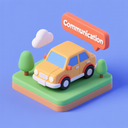
Communication Car 3D isometric – Free icon download
Download all to grab every PNG variant.
The icon in question is a meticulously crafted digital visual representation that seamlessly integrates three powerful and distinct conceptual elements: Communication, Car, and 3D isometric. This fusion creates not just a static image, but a dynamic symbol that embodies modern connectivity, mobility, and technological design. The icon is designed to be instantly recognizable across various digital platforms—such as mobile apps, dashboards, websites, and vehicle interfaces—where clarity and functionality are paramount.
At its core lies the 3D isometric style—a visual language that offers a three-dimensional perspective while maintaining the clarity and precision of two-dimensional design. In this style, objects are rendered from a 135-degree angle, allowing for depth perception without distortion. The car in this icon is not just a flat silhouette or a simple outline; it is an intricately layered structure composed of geometric planes—each face clearly defined with consistent depth and perspective. This approach enables viewers to perceive volume, angles, and spatial relationships at a glance. The 3D isometric technique ensures that the viewer doesn't just see the car but understands its form in a way that feels tangible and real.
The integration of Communication into this design is not superficial—it is deeply embedded into the structure of the icon. Communication, in this context, goes beyond mere messaging or phone calls; it represents data exchange, information flow, and connectivity. The car itself becomes a vessel for communication—its body acts as a conduit for signals. For instance, small circular nodes or flowing lines are integrated along the sides of the vehicle's frame: these represent wireless signals (Wi-Fi, Bluetooth), data transmission paths, and digital networks. These elements are rendered in soft gradients or subtle animations (in interactive versions) to suggest dynamic connectivity in motion.
Specifically, at the front of the car—where a dashboard would typically be—the icon features a stylized communication hub. This hub contains interconnected lines that radiate outward like neural pathways, symbolizing how information flows from and within the vehicle. The dashboard panel itself is designed with transparent surfaces and glowing elements to suggest active data streams—such as GPS navigation, voice commands, or real-time traffic updates. These visual cues are not just decorative; they serve a functional purpose: they immediately communicate that the car is not only in motion but also engaged in intelligent, real-time communication with external systems.
The Car element is central to this icon’s identity. It reflects modern automotive technology—emphasizing smart vehicles, electric models, and autonomous features. The design avoids clichés such as traditional engine blocks or smoke effects. Instead, it focuses on clean lines, minimalist shapes, and a futuristic aesthetic that aligns with current trends in automotive innovation. The car’s wheels are represented with smooth circular forms that suggest motion and forward progression. Importantly, the isometric angle allows the viewer to see all four wheels simultaneously—enhancing a sense of balance and stability.
Moreover, the communication infrastructure is not limited to internal systems within the vehicle. The icon includes subtle external signals extending beyond the car’s body—such as thin lines connecting to roadside units, towers, or smart city nodes. These elements show that communication is not confined within a single vehicle but is part of a larger network ecosystem. This reflects real-world developments in connected vehicles and smart infrastructure where cars act as mobile nodes in a broader digital environment.
The 3D isometric nature of the icon ensures that it works effectively across different screen sizes and resolutions. Whether viewed on a smartphone, tablet, or desktop monitor, the depth and spatial relationships remain clear. This makes it highly scalable and adaptable—perfect for use in user interfaces where space is limited but information must be conveyed efficiently.
From a design standpoint, this icon leverages color psychology to reinforce its message. For example, blue tones are used to represent trust and communication (common in digital platforms), while subtle green gradients suggest sustainability and smart technology—key attributes of modern vehicles. The car body itself is rendered in a neutral gray or metallic silver, maintaining elegance without distracting from the core themes.
The icon’s composition follows strong design principles: balance, symmetry, and visual hierarchy. The central axis—the car—serves as a focal point around which communication elements are arranged. This creates a clear visual narrative: the car is not isolated; it is part of an active, intelligent network. Viewers instantly understand that this vehicle is connected, responsive, and capable of exchanging information with its environment.
This concept has wide-ranging applications. In automotive user interfaces, such as infotainment systems or telematics dashboards, the icon can serve as a visual cue for connectivity status. In smart city apps or transportation planning tools, it could represent the role of vehicles in facilitating urban communication networks. It also finds relevance in marketing materials aimed at promoting connected car technologies—where clarity and innovation are essential.
Ultimately, this icon transcends being a mere aesthetic choice. It represents the convergence of mobility and digital intelligence—a symbol that speaks to a future where cars are not just modes of transportation but intelligent agents capable of engaging in real-time communication with people, infrastructure, and data systems. Through its use of 3D isometric design, it creates depth and realism; through its integration of Communication, it conveys connectivity and interactivity; and through the presence of a modern Car, it grounds the concept in real-world technology.
In summary, this icon is more than a visual element—it is a statement. A statement about how vehicles are evolving into intelligent, networked entities that bridge physical movement with digital interaction. It embodies innovation, clarity, and forward-thinking design—all within a single, accessible frame.
"The fusion of Communication, Car, and 3D isometric in this icon creates a powerful visual metaphor for the future of intelligent mobility—where every drive becomes a conversation between vehicle, environment, and user."Create your own icon with our GoGPT AI prompt:
GoGPT