

Communication Car Retro – Free icon download
Download all to grab every PNG variant.
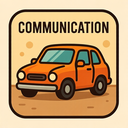
At the heart of this evocative, hand-crafted icon lies a seamless fusion of three powerful themes—Communication, Car, and Retro. This is not merely an abstract symbol; it is a narrative-rich visual experience that transcends traditional iconography. The icon portrays a classic 1970s-era muscle car, unmistakably inspired by American automotive design from the late 20th century—think bold chrome accents, wide grille, rounded fenders, and prominent tail lights. However, this car is not just any vehicle; it is a living hub of communication. It stands as a time capsule where the spirit of analog technology meets the nostalgia of vintage aesthetics while delivering modern functionality.
The most striking feature of this icon is the integration of communication elements seamlessly into the car's design. In its dashboard, instead of conventional gauges or digital screens, one finds a vintage-style radio with a dial and physical knobs that have been retrofitted to emit subtle pulses—visual cues that suggest active transmission. These pulses are represented as soft, glowing waveforms that ripple outward from the dashboard like ripples on water, symbolizing real-time data transfer. The radio is not passive; it emits a faint Morse-like pattern in the background, echoing vintage shortwave signals—a nod to early 20th-century wireless communication. This detail establishes a deep connection between Communication and the car’s core identity.
The Car element is both literal and symbolic. The vehicle itself is styled after a classic American sports coupe or muscle car from the 1970s—think Chevrolet Camaro, Ford Mustang, or Dodge Charger—with a prominent engine hood that seems to "breathe" with subtle animated movement when viewed in motion. The wheels are retro-fitted with rubber tires bearing vintage patterns reminiscent of 1960s road signs and city maps. The car’s roof features a small, curved antenna that extends vertically—designed like an old TV aerial—emphasizing its role as a communication relay point. This integration makes the vehicle not just a mode of transportation but a technological node that connects people, places, and information across distances.
What sets this icon apart is its Retro aesthetic. Every line, curve, and color choice reflects the design language of the 1970s and early 1980s—think warm amber tones for the car’s body, vibrant red accents on trim, chrome detailing that catches light with a metallic sheen, and soft gradient fills reminiscent of old vinyl records. The font used in any text overlay (if present) would be a classic sans-serif typeface such as Helvetica or Arial in bold, slightly stylized to mimic the look of typewriters or early digital displays. Even the shadows and lighting effects are designed with a vintage film aesthetic—soft, diffused halos that give depth without modern sharpness.
But beyond its visual appeal, this icon carries deeper significance. In a world increasingly dominated by digital communication and autonomous vehicles, the fusion of retro design with functional connectivity serves as a reminder of the human side of technology. The car becomes a symbol of connection—not just between people via voice or text, but between generations through shared nostalgia and cultural memory. It represents how communication has evolved: from analog radios to satellite systems, but still rooted in the warmth and simplicity of early forms.
Moreover, this icon functions as a metaphor for modern living—where classic design principles meet contemporary needs. The retro elements provide familiarity and emotional comfort; they anchor users in a sense of identity and continuity. At the same time, the communication aspect ensures that these familiar forms are not obsolete but rather enhanced with new capabilities. Whether it’s connecting remote families through video calls, sharing real-time updates via an embedded system, or even broadcasting local events through a community radio feed—this car becomes a platform for social interaction.
Visually, the icon is balanced and dynamic. The car occupies the central space, with communication elements radiating from its sides and top. A subtle network of lines connects the dashboard to abstract nodes in the sky—representing wireless signals reaching distant locations. These nodes are stylized like old telephone booths or radio towers, blending into a cityscape that appears in soft pastel tones. This layer reinforces the idea that communication is not just about immediate connection but also about building networks and communities.
Additionally, when viewed on a mobile device or digital interface, the icon adapts—its retro textures slightly blur at lower resolutions to maintain readability while preserving its core essence. In high-resolution displays, intricate details like hand-drawn wiring patterns in the dashboard or flickering analog meter readings come into focus. This adaptability ensures that the icon remains relevant across platforms and user experiences.
In conclusion, this icon is more than a simple combination of keywords; it is a powerful cultural symbol. It embodies Communication through active data transfer and emotional exchange, Car through its grounded, nostalgic form as a mode of travel and interaction, and Retro through deliberate design choices rooted in the past. Together, these elements create a harmonious balance between memory and progress—an icon that celebrates how technology can honor tradition while still serving modern human needs. It speaks to us not just as users or designers, but as people who value connection, heritage, and the enduring beauty of simplicity in a complex world.
Create your own icon with our GoGPT AI prompt:
GoGPT