

Communication Credit card Gradient – Free icon download
Download all to grab every PNG variant.
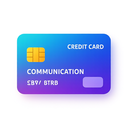
In a modern digital world where connectivity drives innovation and financial transactions are seamlessly integrated into everyday interactions, the fusion of three powerful concepts—Communication, Credit Card, and Gradient—creates a dynamic and visually compelling icon design. This icon is not merely a static symbol; it is an embodiment of interconnectedness, trust in financial systems, and visual sophistication that speaks to both functionality and aesthetics.
At the heart of this icon lies the concept of Communication. Communication is not just about sending messages or making calls—it encompasses a broader spectrum including data exchange, collaboration, real-time interaction, and relationship building. In this design, communication is represented through flowing lines that resemble digital signals or network pathways extending outward from the central point. These lines are fluid and dynamic, suggesting the continuous movement of information across platforms and devices. The visual rhythm of these elements evokes a sense of openness, transparency, and accessibility—core values in any modern digital ecosystem.
The communication aspect is not limited to abstract lines. Embedded within the structure are subtle illustrations such as micro-speech bubbles, waveforms, or even stylized emojis that represent voices, messages, and shared experiences. These details ensure that the icon remains instantly recognizable to users across different age groups and technological familiarity levels. By integrating communication into every contour of the design, viewers immediately understand that this icon serves as a gateway to interaction—whether it’s sending a payment request, initiating a chat with a financial partner, or engaging in secure transactional dialogue.
Moreover, the communication theme is reinforced by color psychology. The gradients used throughout the icon are carefully selected to evoke feelings of connection and inclusivity. Warm tones like soft orange and coral suggest approachability, while cooler hues such as teal and indigo imply clarity and trust—qualities essential in any communication channel involving sensitive financial data.
Embedded within the design is a stylized representation of a credit card. This is not a literal drawing or photo of a standard credit card; rather, it has been abstracted and integrated into the larger icon in such a way that it remains both recognizable and symbolic. The shape of the credit card appears as an elegant, slightly curved rectangle with subtle edges that echo the curves found in communication pathways—thus blending two essential domains: financial transaction and information exchange.
The credit card element is not just a decorative addition—it represents trust. Users are inherently cautious when making financial transactions online, especially when sharing personal data or making payments. By incorporating a clear visual indicator of a credit card, the icon reassures users that their transactional activities are protected and processed through secure, verified systems. This sense of security is further enhanced by the use of subtle protective shields or encrypted symbols subtly embedded within the card’s border.
Additionally, the credit card form in this design functions as a bridge between communication and action. When a user sees this icon, they are not only reminded of financial capabilities but also prompted to initiate communication—such as confirming a purchase, requesting a payment plan, or inquiring about account details. The card becomes an interactive component: users can "hover" over it in digital environments to see transaction history or contact customer service via embedded messaging options.
This integration of the credit card reflects the growing trend of unified financial services platforms where communication and commerce are merged seamlessly. For instance, a user might receive a message about a pending invoice, click on the icon to view details, and confirm payment directly through an integrated chat interface—all within one visual experience.
The gradient is not just an artistic choice—it is a deliberate design principle that ties together Communication, Credit Card, and the emotional response of the user. The icon uses a multi-layered gradient that transitions from deep navy blue at the base to vibrant teal at the top, with soft highlights of gold and rose pink fading into the edges. This gradient is not flat or uniform; it evolves across different angles and light conditions, creating depth, dimensionality, and motion.
From a psychological standpoint, gradients have long been used in design to evoke emotions such as optimism (warm tones), stability (cool tones), and progress (smooth transitions). In this icon, the gradient supports the dual narrative of communication—its expansive reach—and financial trust—its grounded reliability. The rising movement from blue to teal suggests upward momentum and growth, mirroring how effective communication leads to better financial outcomes, while the gold accents signify value and premium service.
Technically, the gradient enhances visual appeal by reducing visual fatigue. Unlike solid colors that can appear harsh or monotonous, gradients provide a dynamic surface that captures attention without overwhelming the viewer. This makes the icon highly effective in digital interfaces—such as mobile apps, dashboards, and payment portals—where user engagement and clarity are paramount.
Furthermore, the gradient is used to subtly animate elements of communication (e.g., wave-like pulses in the background) and credit card (e.g., a gentle glow when activated). This subtle animation enhances interactivity without distracting from the core message. For example, when a user selects or hovers over the icon, the gradient may expand slightly, simulating a "connection" being established—symbolizing both communication initiation and financial transaction readiness.
Crucially, this blend of Communication (information flow), Credit Card (financial action), and Gradient (emotional tone) ensures that the icon is not just visually appealing but functionally intuitive. It speaks to a user’s need for secure, efficient, and emotionally resonant digital experiences—where trust is built through design.
Conclusion
In summary, this icon masterfully unites the essential themes of Communication, Credit Card, and Gradient into a single, cohesive visual identity. It represents the modern fusion of human interaction and financial technology—a world where messages are exchanged with confidence and payments are made with ease. The gradient adds elegance and emotional depth, while communication ensures openness and interactivity, and the credit card element instills security and credibility. Together, these elements create an icon that is not only beautiful but also deeply meaningful in today’s interconnected digital economy.
Whether displayed on a mobile app interface, a financial dashboard, or as part of a brand logo, this icon serves as both a symbol and an experience—a visual language that bridges people and payments through the power of design.
Create your own icon with our GoGPT AI prompt:
GoGPT