

Communication Credit card Origami – Free icon download
Download all to grab every PNG variant.
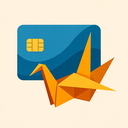
Description of the Icon: "Communication, Credit Card, and Origami"
The icon titled "Communication, Credit Card, and Origami" is a richly symbolic visual composition that beautifully fuses three distinct yet interconnected concepts—Communication, Credit card, and Origami. This intricate design transcends simple representation; it embodies a narrative of modern human interaction, financial trust, and cultural craftsmanship. At first glance, the icon appears to be an artistic synthesis where form meets function, tradition meets technology, and personal connection merges with economic exchange. Each element is carefully placed not only for aesthetic balance but also for deeper meaning—creating a multi-layered visual metaphor that invites interpretation and reflection.
At the center of the icon stands a delicate origami crane, crafted with precision and grace. This crane is not merely decorative—it symbolizes Communication. In Japanese culture, the origami crane is traditionally associated with peace, hope, and messages passed across distances. The act of folding paper into a bird reflects intentionality in message delivery—every fold represents a deliberate step in conveying thought or feeling. The crane’s wings are slightly open, suggesting movement and openness to exchange; its gaze is upward, indicating aspiration toward connection and understanding. This central figure serves as the emotional core of the icon, emphasizing that communication is not just about sending information but about building bonds through thoughtful expression.
Surrounding the crane on one side is a stylized credit card—its surface slightly curved to resemble an origami fold, blending seamlessly with the surrounding paper texture. The credit card features subtle lines and patterns reminiscent of origami creases, indicating that financial systems are not separate from cultural artistry. This fusion signifies that Credit card is more than a tool for transaction—it's a symbol of trust, reliability, and human interaction in today’s interconnected world. In the context of communication, money often mediates relationships—whether it’s paying for a message service, supporting digital platforms, or enabling global collaboration through payment systems. Thus, the credit card here acts as a bridge between personal exchange and economic reality.
On the opposite side of the crane, a cluster of small origami elements—such as paper boats floating on an imagined river and folded paper lanterns suspended in mid-air—reinforces the theme of Origami as an art form deeply rooted in symbolism and intention. These items represent diverse forms of communication: the boat may symbolize a message sent across distances, while the lantern suggests illumination in darkness—guiding others through uncertainty. The origami elements are rendered with soft gradients, giving them a gentle, human touch. Each piece reflects how traditional crafts can be used metaphorically to express emotions and intentions that words alone cannot capture.
The entire composition is set against a background of subtle wave-like lines resembling both ocean ripples and digital signal waves. This blending of natural movement with data flow reinforces the concept that communication thrives on fluidity, adaptability, and continuity. The wave pattern subtly overlaps with the folds in the origami paper, creating a visual harmony between tangible art and intangible information flow. This background emphasizes that communication is not static—it evolves, bends, and adapts to different contexts.
Furthermore, the icon incorporates subtle color symbolism. The crane is rendered in soft blues and whites—colors associated with trust, clarity, and peace. The credit card features a muted silver hue with a subtle green border to represent financial stability and growth. The origami elements use pastel tones that evoke warmth, nostalgia, and cultural continuity. Together, these colors create an atmosphere of balance between modernity (financial systems) and tradition (paper art), suggesting that effective communication must integrate both innovation and heritage.
From a design perspective, the icon balances complexity with clarity. It avoids clutter by maintaining visual hierarchy: the crane is dominant, while the credit card and origami details are integrated in a way that supports rather than overwhelms. The use of negative space between elements allows viewers to pause and reflect on each component’s role in the larger narrative. This intentional spacing also reflects how communication requires breathing room—time for thought, reflection, and response.
Psychologically, the icon appeals to human values such as trust, empathy, and cultural belonging. In a world increasingly driven by digital transactions and impersonal interactions, this piece reminds us that meaningful connection still depends on personal touch—whether through handwritten letters (an origami metaphor), thoughtful financial support (credit card), or open dialogue (communication). It suggests that true communication is not just about information transfer, but about shared values, mutual respect, and cultural awareness.
Additionally, the fusion of these three elements speaks to a growing global trend where traditional practices are being reimagined in digital or modern contexts. For example, origami-inspired designs are used in product packaging and UX interfaces; credit cards now offer seamless integration with messaging apps; and communication platforms increasingly support creative expression through media sharing. The icon thus becomes a visual manifesto for this convergence—where technology doesn’t replace tradition but enhances it.
In conclusion, the "Communication, Credit Card, and Origami" icon is far more than a simple artistic piece. It is a powerful symbol that unites emotional depth with practical functionality. By merging the timeless art of origami with the modern utility of credit cards and the universal need for human connection, it creates a resonant image that speaks to both personal experience and societal evolution. Whether used in design systems, educational materials, or branding campaigns, this icon encourages users to reflect on how we communicate, transact, and create meaning in a complex world. It stands as a reminder that behind every transaction lies a story—and behind every story is the delicate art of connection.
Create your own icon with our GoGPT AI prompt:
GoGPT