

Communication Credit card Retro – Free icon download
Download all to grab every PNG variant.
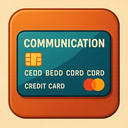
The "Communication, Credit Card, Retro" icon is a distinctive and thoughtfully crafted visual symbol that seamlessly fuses three powerful and contrasting themes: Communication, Credit Card, and Retro. This icon serves not only as a functional graphical element but also as a narrative piece—a bridge between modern digital interaction, financial transactions, and nostalgic design aesthetics. Its purpose is to communicate in an instantly recognizable way the intersection of personal exchange, economic activity, and vintage style.
At its core, the icon embodies Communication. In today’s hyper-connected world, communication transcends mere text or voice; it encompasses digital transactions, shared data, and real-time exchanges. The icon visually reflects this by integrating a stylized waveform or a series of interconnected lines that resemble speech bubbles or network signals—elements commonly associated with digital conversations. These waveforms are not static; they pulse subtly in an animated version of the icon, suggesting continuous interaction and flow of information. This dynamic communication pattern is carefully balanced with other visual components to avoid clutter, ensuring clarity even at small sizes.
Embedded within the communication motif is a central Credit card element. The credit card portion is rendered in a classic, simplified form—a rectangular shape with rounded corners and a subtle metallic sheen—evoking the tactile quality of real-world payment cards. However, instead of being a straightforward representation, it is stylized with retro details: the embossed logo may feature a vintage font (like Helvetica or Futura), and the card’s border features faint lines resembling old mechanical circuitry or typewriter keys. The card is not just a passive object; it actively participates in communication by serving as both a transactional tool and an identity token. For example, one corner of the icon may feature a small, stylized "CC" monogram that merges with the waveforms to suggest that financial transactions are part of everyday conversations—whether online shopping, digital payments, or peer-to-peer transfers.
What truly sets this icon apart is its Retro aesthetic. This is not a superficial nod to vintage design; it’s a deliberate and immersive integration of 1980s and 1990s design principles. The color palette features muted tones such as faded teal, warm coral, and sepia brown—colors reminiscent of early digital interfaces, CRT screens, or analog televisions. The lines are bold yet hand-drawn, with slight imperfections to give the impression of being created by a retro illustration style (think of vintage comic books or early computer graphics). Shadows are soft and gradient-based rather than sharp and modern, adding depth without sacrificing warmth. Even the typography used in the icon’s label or surrounding text is carefully chosen—sans-serif fonts with a slightly off-center alignment, as if printed on an old fax machine.
The retro influence extends beyond color and form. The overall composition echoes classic design layouts from the early days of computing, such as those found in Apple II or Commodore 64 interfaces. The icon is structured like a small terminal screen with a blinking cursor positioned at the bottom edge—symbolizing an active communication channel ready for input or transaction initiation. This feature subtly reinforces that communication and payment are not isolated functions but part of an ongoing, interactive experience.
Functionally, this icon could be used across various digital platforms—mobile apps, financial dashboards, social media interfaces, or even in educational tools focused on digital literacy. For instance, in a fintech app that emphasizes user engagement and trust-building through transparent communication channels (such as chat support or secure payment notifications), the "Communication, Credit Card, Retro" icon would act as a visual cue that both financial security and open dialogue are central to the platform’s values.
Moreover, the retro design helps create an emotional connection with users. In an era dominated by sleek, minimalist interfaces and artificial intelligence-driven interactions, this icon offers a sense of familiarity and warmth. It invites users to feel less alienated from technology—instead of being overwhelmed by data or complex menus, they see a symbol that feels human, nostalgic, and approachable. This emotional layer is critical in building user confidence when dealing with sensitive financial information.
The interplay between the three key elements—Communication, Credit Card, and Retro—is carefully choreographed. The credit card is not simply placed beside the communication waveforms; it flows organically into them. For example, a small ripple from one end of the waveform may appear to “touch” or "merge" with a corner of the card, suggesting that every transaction begins with conversation—whether it’s asking for a purchase recommendation, confirming payment details, or resolving a dispute. This integration makes the icon more than just a symbol; it becomes a story in motion.
From an artistic standpoint, this icon is designed to be scalable and versatile. It works well in both vector-based applications and raster graphics due to its clean lines and balanced composition. It can be used as a standalone logo or integrated into complex interface designs, such as payment gateways, messaging platforms with financial features, or educational content about digital economies.
In conclusion, the "Communication, Credit Card, Retro" icon is more than a visual design—it is a symbol of modern human interaction where technology meets trust and personal connection. By combining the functional aspects of communication and finance with the emotional resonance of retro design, it offers users a unique experience that feels both familiar and forward-thinking. It serves as a reminder that while we live in an increasingly digital age, our need for honest dialogue, financial transparency, and nostalgic warmth remains unchanged. This icon is not just about what it represents—it's about how it makes users feel when they see it.
Create your own icon with our GoGPT AI prompt:
GoGPT