

Communication Road Steampunk – Free icon download
Download all to grab every PNG variant.
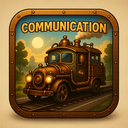
The "Communication, Road, and Steampunk" icon is a richly layered artistic representation that fuses three distinct yet deeply interconnected themes: Communication, Road, and Steampunk. This intricate design transcends mere visual appeal—it embodies a narrative of progress, connection, and industrial innovation rooted in the spirit of the 19th-century industrial revolution. Each element within the icon is not only symbolic but functionally integrated to create a seamless blend of storytelling and aesthetic expression.
At its core, the icon draws heavily from the steampunk genre—a speculative art style that imagines a world where steam-powered machinery, brass gears, copper pipes, and intricate clockwork dominate technology and society. The visual language of this icon is saturated with classic steampunk motifs: brass-capped conduits resembling ancient arteries running through the composition, cogs of varying sizes interlocking like mechanical hearts, and polished iron frameworks that suggest a fusion between industrial strength and elegant design. The color palette is dominated by warm tones—bronze, rust reds, deep copper, and weathered silver—evoking the look of time-worn machinery exposed to both the elements and human use.
Every surface of the icon appears hand-crafted, as though assembled from vintage brass instruments or antique telegraph equipment. The edges are slightly oxidized to suggest age and history, adding a sense of authenticity. Small cogs rotate subtly in the background, suggesting motion and continuity—this subtle animation (even in still form) gives life to the composition. Steam vents rise like wisps from certain nodes, emitting faint blue or gray vapor that gently curls around communication lines. These details not only reflect steampunk's love of mechanical complexity but also serve as a visual metaphor for innovation emerging from industrial foundations.
Embedded within the steampunk framework is a strong emphasis on the concept of "Road"—a literal and symbolic pathway. The central axis of this icon is a vast, winding road made entirely from interlocking metal plates, forged in the shape of ancient railway tracks and early auto routes. This road winds through a mechanical landscape, crossing over bridges composed of gear assemblies and spanning chasms filled with rotating pistons that mimic the motion of locomotives.
The road is not just a passive element—it actively functions as a dynamic conduit. In places, it features embedded signal lights made from glass lenses and oil lamps, pulsing rhythmically to indicate movement or activity. These signals are synchronized with the cogs and gears surrounding them, creating an organic rhythm that echoes real-world traffic patterns or communication pings. The road serves as both a physical space for travel and a metaphorical pathway for information exchange—showcasing how people, data, and ideas move across distances through infrastructure.
Along the edges of the road, small steam-powered carts with brass wheels roll slowly forward. These are not mere decorations; they represent real-world analogs to modern vehicles—vehicles that once carried goods and people before digital communication revolutionized transport. Each cart is equipped with a small brass telegraph receiver on its side, suggesting that even in this industrial world, information travel was integral to movement and coordination.
Communication is the beating heart of this icon. It does not exist as a separate element but rather as an integrated network woven through every part of the design. The most prominent feature is a vast web of copper wires, steam-powered telegraph lines, and pneumatic tubes that stretch from one end of the road to the other. These communication channels are not just static cables—they are alive with subtle motion: tiny valves open and close in rhythm with distant pulses, mimicking real telegraph signals.
At key junctions along the road, large brass telegraph stations emerge like clock towers. Each station features a rotating drum that displays Morse code symbols—some flashing red and green lights to simulate signal transmission. These drums are connected via pneumatic tubes filled with compressed air, which transmit messages across the landscape in real time. The icons of letters and numbers appear on these devices, forming words like "HELLO," "MESSAGE DELIVERED," or "ROAD CLOSED" as if being transmitted between nodes.
The communication network also extends into the sky. High above the road, a series of steam-powered aerial platforms—resembling dirigibles or early flying machines—are tethered to the metal framework. These aircraft are equipped with large brass signal flags that wave in unison, forming messages visible from afar. They represent long-distance communication, allowing information to travel beyond physical roads and into the realm of open sky.
What makes this icon truly unique is how Communication, Road, and Steampunk are not just present—they interact dynamically. The road enables communication by providing a path for people and vehicles to carry messages; the steampunk machinery gives that communication a sense of authenticity, history, and mechanical elegance. Meanwhile, communication itself becomes the lifeblood of the road—without signals or messages being exchanged between stations, movement would be chaotic and inefficient.
For instance, when a telegram arrives at one end of the road via steam tube, it triggers a sequence: gears in the telegraph station turn into cogs that activate nearby valves on the road infrastructure. This results in the opening of gates or changes in traffic flow—showing how information directly influences physical movement. This symbiotic relationship reflects real-world systems where communication governs logistics, transportation, and urban planning.
The icon thus becomes more than a static image—it is a living model of an industrial society where technology, infrastructure, and human interaction are in constant dialogue. It speaks to both the historical roots of communication networks (like telegraphy) and their evolution into today's digital systems, while maintaining a timeless aesthetic that celebrates craftsmanship and mechanical ingenuity.
In sum, the "Communication, Road, and Steampunk" icon is a powerful fusion of historical inspiration and modern thematic relevance. It offers a vivid vision of how information travels through physical spaces via mechanical means in an industrial age—where roads are not just pathways but conduits for exchange. The steampunk style provides both visual beauty and cultural depth, grounding the narrative in a richly imagined world that feels both familiar and fantastical. Together, these elements create a compelling symbol of connectivity, progress, and enduring human ingenuity—making it ideal for use in design systems that emphasize historical themes with forward-thinking applications.
Create your own icon with our GoGPT AI prompt:
GoGPT