

Communication Train Line art – Free icon download
Download all to grab every PNG variant.
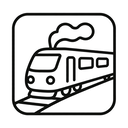
Icon Description: A Symbol of Communication, Train, and Line Art – An Integrated Visual Narrative
This meticulously designed icon embodies the powerful synergy between Communication, Train, and Line art. Crafted with precision and intention, it serves not only as a visual symbol but also as a meaningful representation of how information travels, connects people, and moves efficiently through structured systems—particularly within the realm of transportation and human interaction. At its core, the icon is an elegant fusion of minimalist line art, dynamic train movement, and clear communication pathways. Each element has been thoughtfully composed to reflect clarity, simplicity, and functional elegance—hallmarks that define high-quality line art while ensuring universal understandability across diverse audiences.
The icon begins with a stylized representation of a train—a classic symbol of movement, progress, and connectivity. However, rather than depicting a generic locomotive with detailed wheels or windows, the train is rendered using clean, continuous line art. Its structure is composed of smooth curves and straight lines that flow seamlessly from one end to the other. The front of the train features a pointed silhouette reminiscent of a modern passenger car or a streamlined freight unit, with an absence of unnecessary details. This minimalist approach emphasizes clarity and focus, ensuring that viewers can instantly recognize the form without cognitive overload. The use of line art here not only enhances visual appeal but also ensures scalability across different platforms—digital interfaces, signage, print media—without losing fidelity.
What makes this icon truly distinctive is how the train is integrated with a network of intersecting lines that represent communication. These lines do not simply trace the path of the train; instead, they radiate outward from its center like signals or data pathways. Each line carries a subtle gradient or directional arrow, indicating flow and movement. The communication network forms an elegant web around and beneath the train—suggesting that every journey is accompanied by a continuous exchange of information: schedules, updates, alerts, passenger messages, real-time tracking data—all vital components of modern transportation systems.
The communication elements are designed to be both literal and metaphorical. Literally, they represent digital and physical channels through which travelers receive information—such as train departure times via mobile apps or station announcements. Metaphorically, the lines symbolize how people connect during travel—through shared experiences, conversations in waiting rooms, group rides on commuter trains, or even social media interactions that begin at a railway station. The interplay between the train and these communication lines suggests that movement is not just physical; it is also an emotional and social journey where connection is fostered along the way.
The icon’s aesthetic foundation lies in its line art composition. Every stroke is deliberate, using only black or a single, neutral tone to create depth and contrast. There are no gradients, textures, or fills—only clean lines that define form and function. This minimalist approach is both timeless and modern, aligning with contemporary design principles such as flat design and user-centered interface development. Line art’s strength lies in its ability to be instantly recognizable even at small sizes or when viewed on low-resolution screens—a critical feature for icons used in mobile apps, dashboards, or public transport applications.
The integration of train as a central motif is not arbitrary. Trains represent order, reliability, and scheduled communication—key qualities in any system where timely information transfer is essential. Whether it’s coordinating departures between cities or enabling real-time updates during disruptions, the train serves as a metaphor for structured systems that facilitate communication. In this way, the icon reflects real-world applications such as transit management platforms, railway signaling systems, or smart city infrastructure where data flows seamlessly from station to station.
Furthermore, the visual balance between Communication and Train creates a dynamic harmony. The train is not merely a passive object; it becomes an active participant in the communication process. For instance, as the train moves forward along its track, each line branching from it pulses gently—symbolizing data transmission in real time. This visual rhythm suggests that communication is continuous and responsive, much like how a live tracking system updates passengers with current status. It reinforces the idea that transportation systems are not just about movement; they are also about information sharing and user engagement.
From a design standpoint, this icon is highly adaptable. It can be used in various contexts: as a navigation tool in travel apps, an emblem on train station signage, or even as part of a larger infographic illustrating urban mobility and data flow. Its simplicity ensures that it remains effective across cultures and age groups—children can easily recognize the train shape, while professionals appreciate the subtle communication network.
Moreover, this icon transcends its literal purpose to become a universal symbol of connection. In today’s world, where digital communication is omnipresent and physical travel is increasingly coordinated through smart technology, this icon represents a bridge between physical movement and information exchange. It captures the essence of how trains—once isolated mechanical systems—have evolved into integral nodes in broader networks of communication.
In summary, this icon masterfully merges Communication, Train, and Line art into a single, cohesive visual. It is not just an illustration—it is a narrative about how information moves with physical systems. Through minimalist line art, it achieves clarity and scalability while using the train as both a literal and symbolic element of connectivity. Whether viewed on a smartphone screen or printed on station maps, this icon serves as a powerful reminder that movement and communication are inseparable parts of modern life.
Designed with purpose, precision, and visual harmony, this icon stands as an excellent example of how simple forms can convey complex ideas—proving that in the world of design and communication, less is often more.
Create your own icon with our GoGPT AI prompt:
GoGPT