

Construction Bridge Digital glitch Free icon download
Download all to grab every PNG variant.
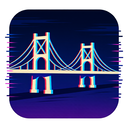
The icon is a meticulously crafted visual representation that seamlessly fuses the themes of construction, bridge, and a striking element of digital glitch. At first glance, it presents an image that appears both technologically advanced and structurally grounded—a paradoxical yet harmonious blend that captures the essence of modern infrastructure in the digital age. The central motif is a stylized, elevated steel bridge arching gracefully across a horizontal plane, symbolizing connectivity and progress. However, this otherwise solid structure is interrupted by cascading digital distortions that fracture its form like lightning through glass.
The bridge itself is rendered with precision and engineering integrity—its structural components are clearly defined: I-beams, tension cables, support pylons, and riveted joints. The color palette leans toward industrial realism: steel grays interwoven with hints of rust-red for aged metal elements, suggesting a structure that has stood the test of time. Yet, this realism is deliberately disrupted by digital artifacts—sudden shifts in hue, pixelation bursts, and chromatic aberrations that ripple across the bridge's surface like corrupted data streams. These glitches do not appear randomly; they follow a calculated path along critical structural points—the joints between beams, the center of the arch’s apex, and where cables meet their anchoring points—emphasizing how digital corruption can target essential infrastructure.
As you focus on the construction elements, it becomes apparent that this bridge is not fully complete. Partially constructed trusses extend from either side toward a central void where the main span should be, suggesting an ongoing project in progress. The work-in-progress nature of the structure is reinforced by subtle visual cues: scaffolding lines drawn with dotted white strokes, temporary support beams made of translucent wireframes, and construction signage—some reading “Work in Progress,” others displaying corrupted text like “ERROR 404: STRUCTURE NOT FOUND.” This deliberate imperfection reinforces the theme of construction as a process—dynamic, evolving, and susceptible to error.
The most compelling feature of the icon is its integration of digital glitch effects. These are not merely decorative; they serve a narrative function. The glitches manifest as fragmented lines that split the bridge's steel beams into geometric shards, each piece slightly offset from its original position—creating a sense of misalignment and instability. Some sections flicker between two states: one clean and complete, the other corrupted with pixelated distortion or data noise resembling Morse code or binary strings (01011010). The effect is hypnotic—the eye jumps between what the bridge should be and what it has become under digital influence.
In the background, a faint network grid overlays the entire composition—thin lines in electric blue forming a lattice that connects key points of the bridge. This grid symbolizes both digital infrastructure (like fiber-optic networks) and urban planning schematics. It subtly suggests that modern construction is no longer just about concrete and steel; it's deeply entwined with data systems, AI-driven design algorithms, and real-time monitoring—systems that are themselves vulnerable to glitches.
Color transitions within the icon further enhance its thematic depth. The base of the bridge uses earthy tones—dusty browns and weathered greens—to ground it in physical reality. As the structure ascends, colors shift into cooler, digital hues: cyan, magenta, and neon yellow. This gradient from natural to synthetic reflects humanity’s increasing reliance on technology in engineering projects. Yet at key moments—especially where glitches are most intense—the color palette breaks down: saturation spikes violently before collapsing into monochrome static or black-and-white noise.
The icon’s overall shape is balanced and symmetrical, yet the asymmetry introduced by glitch elements creates dynamic tension. This reflects a larger cultural and technological narrative: our ambition to build enduring structures (bridges of connection) is constantly challenged by the fragility of digital systems that power them. The construction phase becomes metaphorical—the bridge represents not just physical transit, but also data transmission, societal integration, and future planning—each vulnerable to technical failure.
In summary, this icon transcends mere visual representation. It is a conceptual fusion: a bridge in the making (construction), spanning between two points of significance (connection), with digital interference disrupting its stability and continuity. The glitch is not an accident—it’s the central theme. It reminds us that even our most ambitious projects are only as strong as the systems that support them—and when those systems fail, the foundation itself begins to fracture.
Create your own icon with our GoGPT AI prompt:
GoGPT