

Construction Credit card Metallic Free icon download
Download all to grab every PNG variant.
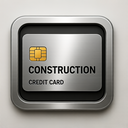
The icon in question is a masterful fusion of three distinct yet harmoniously integrated concepts: Construction, Credit Card, and Metallic. At first glance, it presents a sleek, modern silhouette that commands attention through its precise geometry and reflective surface. Upon closer inspection, the icon reveals layers of meaning—each detail carefully crafted to represent a blend of industrial strength, financial credibility, and cutting-edge design.
At its core, the icon takes on a rectangular form reminiscent of a standard credit card—measuring approximately 85.60 mm × 53.98 mm in real-world dimensions (the ISO/IEC 7810 ID-1 standard). This foundational shape immediately signals familiarity and financial relevance. However, rather than being a flat, inert rectangle, the icon is elevated through intricate three-dimensional modeling that gives it a sense of physicality and presence. The edges are subtly chamfered to mimic the rounded corners of an actual credit card, reinforcing its real-world functionality while maintaining an elegant aesthetic.
The most striking feature of this icon is its metallic finish. It is rendered with a highly polished chrome-like surface, reflective and luminous under virtual lighting. This metallic texture isn't merely decorative—it serves as a metaphor for durability, modernity, and high value. Light reflects off the surface in dynamic patterns depending on viewing angles, creating the illusion of movement even when static. The sheen captures ambient light with precision—shadows are sharp and well-defined, highlights are crisp and intense—giving the icon a sense of weightlessness despite its implied solidity. This polished metallic quality evokes industrial-grade materials like stainless steel or titanium alloy, suggesting strength and long-term resilience.
Embedded within the card-like form is an abstract yet purposeful representation of construction. Instead of traditional architectural imagery such as blueprints or buildings, the icon integrates construction elements through its surface detailing. The background texture resembles a grid of interlocking steel beams, subtly etched into the metallic plane. These beams are not random; they follow a precise, modular pattern—each line spaced evenly to suggest engineered precision and structural integrity. At key intersections of these grid lines, small rivets or bolt-like dots appear—tiny metallic protrusions that simulate real construction fasteners. The result is a surface that feels both solid and dynamic: like a high-rise foundation or a bridge support rendered in metal.
Further enhancing the construction theme are subtle geometric patterns resembling building blocks or modular units. These are not overly prominent but serve as micro-features visible only upon zooming in—such as small, hexagonal cells arranged into larger clusters, evoking the image of a scaffolding framework or a prefabricated panel system. This layering of structure within structure emphasizes scalability and adaptability—the hallmark traits of modern construction practices. It suggests not just static building but ongoing development and progress—perfectly aligning with the idea that financial systems (like credit) are built on robust, foundational frameworks.
The credit card aspect is symbolized through a series of carefully placed, minimalist elements. Along the lower edge of the icon, a faint magnetic stripe appears—depicted as a thin black band with subtle silver speckles that suggest data encoding. Above it, in crisp white text (resembling engraved typography), the label "CREDIT" is inscribed in uppercase letters. The font is sans-serif and clean—typical of modern financial branding—emphasizing clarity and trustworthiness.
Centered on the card’s face, a stylized credit symbol—a circular emblem with a stylized ‘C’ inside—is etched with precision. This emblem is not flat but appears recessed slightly into the metallic surface, giving it depth and tactile realism. It is bordered by an intricate ring of interwoven lines that form a protective casing, reinforcing the notion of security and integrity—essential in both construction and financial systems.
Perhaps most innovative is how all three themes converge through a central motif: a rising crane silhouette, subtly integrated into the card’s upper third. Instead of appearing as a standalone image, this crane is formed by negative space—the metal around it is cut away to create the outline of the structure. The crane’s arm extends upward at an angle, as if lifting not just materials but future possibilities. This detail serves as a powerful metaphor: credit enables growth (construction), and metallic construction underpins financial stability.
The icon’s color palette reinforces its themes: predominantly silver and chrome with hints of deep charcoal gray for contrast, punctuated by a single accent of rich royal blue in the credit symbol—representing trust, professionalism, and reliability. No vibrant colors detract from the icon's sophistication; instead, it maintains a professional tone suitable for banking applications, enterprise software interfaces, or construction finance platforms.
In summary, this icon transcends mere representation. It is a symbolic amalgamation of construction (through structural gridwork and modular design), credit card (via familiar form factor and financial cues), and metallic (through reflective surface, industrial texture, and material authenticity). Every element—whether visible at a glance or discovered through close examination—serves a dual purpose: to inform the user while inspiring confidence in the underlying systems it represents. It stands as a testament to thoughtful design where function, form, and symbolism are seamlessly interwoven.
Create your own icon with our GoGPT AI prompt:
GoGPT