

Construction Factory Organic Free icon download
Download all to grab every PNG variant.
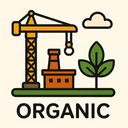
The icon is a meticulously crafted visual representation that seamlessly blends the industrial strength of construction and factory environments with the natural elegance and sustainability of organic forms. It is designed to evoke a sense of balance between human ingenuity and environmental harmony—a symbol for modern innovation rooted in ecological responsibility. At first glance, the icon appears as a stylized geometric structure, but upon closer inspection, its layers reveal an intricate interplay between synthetic precision and biological fluidity.
The central form is a futuristic factory building constructed with clean lines and modular architecture. Its base is composed of sharp angular shapes reminiscent of concrete foundations and steel frameworks—hallmarks of construction sites. The walls are layered in a tessellated pattern, symbolizing the repetitive efficiency found in industrial production. However, instead of cold metallic surfaces, the structure is covered in a living skin: organic vines, mosses, and creeping plants weave through its joints and wrap around its supports. This fusion suggests that even the most rigid structures can be softened and rejuvenated by nature—an emblem of sustainable development.
The factory’s roof is not flat or metallic but instead features a series of domed, leaf-like panels that resemble the scales of a giant plant or the petals of a blooming flower. These panels are subtly angled to capture sunlight, hinting at solar energy integration. At the apex, a small wind turbine gently rotates within an open lattice structure shaped like an abstract tree crown. This detail underscores renewable energy as an integral part of modern factory operations—a critical step in reducing carbon footprints while maintaining productivity.
From the front façade emerges a construction crane, but instead of steel arms and rigid cables, its limbs are formed from twisted branches that mimic the growth patterns of trees. The crane’s hook is shaped like a seed pod, suggesting not just lifting materials but planting ideas and fostering new beginnings. This anthropomorphic touch transforms industrial machinery into an extension of nature—tools that serve both construction needs and ecological regeneration.
At the base of the structure, a series of circular platforms form a ring around the building’s core. These platforms are not made of concrete or asphalt but resemble terraced gardens with soil beds, herbs, and flowering plants. Small irrigation channels mimic blood vessels in leaves, circulating water through micro-drip systems that support plant life while efficiently managing resources. This design reflects the principles of permaculture—sustainable land use where human infrastructure mimics natural ecosystems.
The color palette reinforces the theme: earthy greens dominate, symbolizing growth and organic life. These are accented with warm grays and steel blues—industrial hues—but they are muted and softened, never harsh or aggressive. The contrast is intentional: industrial materials are present but integrated into a living system rather than dominating it. Light gradients simulate sunlight filtering through leaves, casting gentle shadows that shift across the icon’s surface like natural light patterns.
Even the icon’s silhouette suggests movement—organic flow rather than rigid symmetry. Curving pathways spiral upward from the ground, leading toward observation decks and rooftop greenhouses where workers might grow food or conduct environmental research. These elevated spaces are designed with open-air balconies and solar shades shaped like wings or petals, further blurring the boundary between building and ecosystem.
At its core, this icon embodies a philosophy: construction does not have to be at odds with nature. Factories—traditionally seen as sources of pollution—can become catalysts for renewal. And organic systems need not remain isolated; they can thrive within engineered environments when designed with intention and respect for the natural world.
In essence, this icon is more than a visual symbol—it is a narrative of transformation. It speaks to the future: where every brick laid contributes to green infrastructure, where every assembly line serves both human progress and planetary health. The harmony between construction, factory operations, and organic life isn’t just possible; it’s necessary. And this icon stands as a bold reminder that innovation need not come at nature’s expense—it can be its partner.
Whether used in urban planning documents, green technology platforms, or sustainable development campaigns, this icon serves as a powerful emblem of progress that honors both the blueprint and the biosphere.
Create your own icon with our GoGPT AI prompt:
GoGPT