

Construction Piano Organic Free icon download
Download all to grab every PNG variant.
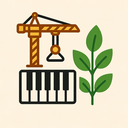
In the realm of modern iconography and visual storytelling, few concepts blend as poetically as the convergence of construction, piano, and organic form. This intricately designed icon is not merely a visual symbol; it is a profound metaphor for harmony between human ingenuity, artistic expression, and the natural world. Through its layered symbolism, this icon transcends mere aesthetics—it invites contemplation on the delicate balance between structure and spontaneity, engineering and emotion.
The foundation of this icon is undeniably construction. At first glance, the form appears as an abstracted architectural element—perhaps a stylized framework or a skeletal outline resembling beams and joints. However, closer inspection reveals that these structural components are not rigid or mechanical; instead, they are crafted with fluidity and grace. The lines of the construction resemble the elegant trusses of a cathedral roof or the interlocking supports in sustainable green architecture. Each beam is subtly angled to suggest motion and balance, evoking a sense of dynamic stability.
What sets this construction apart from traditional blueprints or industrial designs is its intentional imperfection. The joints are not perfectly aligned; some connectors are slightly offset, suggesting a hand-crafted origin rather than mass-produced precision. This deliberate deviation from rigid symmetry grounds the icon in authenticity. It whispers that true construction—whether of buildings, ideas, or emotions—is not about flawless replication but about resilience through adaptation.
Embedded within the skeletal structure is a central motif: a stylized piano key. But this is no ordinary key. It emerges not as a flat rectangle, but as an organically curved element, rising like a leaf from the framework. Its shape mimics both the elegant arch of ivory keys and the contour of a seashell—fusing mechanical precision with natural elegance.
Multiple piano keys radiate outward from this central form, arranged not in a rigid sequence but in a spiral pattern that echoes both musical scales and botanical phyllotaxis—the mathematical arrangement seen in leaves around a stem. The keys vary slightly in height and width, suggesting improvisation rather than strict composition. This deliberate variation implies that music—like life—does not always follow predictable patterns; sometimes the most beautiful moments arise from spontaneity.
At the base of the icon, beneath the piano’s central key, a delicate set of musical notes floats like petals. They are rendered in soft gradients and asymmetrical placement, resembling bird tracks or dewdrops on a leaf. These notes are not written in standard notation but instead composed using symbolic glyphs that suggest melody without defining it—a powerful reminder that music is as much about feeling as it is about form.
The most striking aspect of the icon, however, is its organic character. It defies the cold sterility often associated with construction and musical instruments. Instead, every element appears to grow—rather than be built. The beams twist like tree trunks; the piano keys unfurl like vines; even the joints resemble knuckles or seed pods, suggesting a living organism rather than a machine.
Textures reinforce this organic quality. The surface of the icon is not smooth but has subtle imperfections: soft ridges resembling bark, faint veins resembling leaf networks, and minute fissures that catch light like sunlight through forest canopy. Color palettes reflect nature—earthy greens, warm ochres, deep browns—and are applied with gradients that mimic natural transitions. There is no harsh contrast; instead, hues blend softly into one another, as if the icon were a living organism breathing slowly.
Perhaps most poetically, certain elements appear to be in motion. A single key gently tilts downward as if being pressed by an invisible hand. The surrounding beams seem to lean slightly toward the center, not from gravity but from intention—like trees growing toward sunlight. This subtle animation (if viewed in motion) suggests that construction is not static; it is alive, responsive, evolving.
This icon transcends categorization. It does not belong solely to architecture, music, or nature—it belongs to the space where they converge. The construction represents human effort and intention; the piano, emotional expression and creativity; the organic, life itself—the source of inspiration and sustainability.
In design philosophy, this icon embodies biomimicry: learning from nature’s patterns to create better structures. It challenges the outdated dichotomy between man-made and natural, suggesting that true innovation lies not in dominating nature but in harmonizing with it. The piano keys are not imposed upon the structure—they grow from it. The beams are not just supports; they are veins feeding a living whole.
Ultimately, this icon serves as a visual manifesto for sustainable creativity: that progress need not come at the cost of beauty or ecological balance. It speaks to architects who dream of green cities, composers who seek emotional depth, and designers who believe form should follow life—not control it.
In a world increasingly defined by artificial precision and digital detachment, this icon stands as a quiet yet powerful reminder: that the most enduring constructions are those born from music and nature. They are not built—they are grown. And in their gentle curves and resonant silence, they play the most beautiful symphony of all.
Create your own icon with our GoGPT AI prompt:
GoGPT