

Construction Train Pixel art Free icon download
Download all to grab every PNG variant.
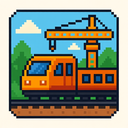
```html The pixel art icon described here is a meticulously crafted representation of a unique fusion between the industrious spirit of construction and the mechanical precision of a train, all rendered in the nostalgic charm of 8-bit pixel art. Measuring precisely 32x32 pixels, this compact yet expressive visual artifact encapsulates an entire narrative within its limited canvas. It is not merely an icon but a miniature story—one that speaks to progress, innovation, and the digital reimagining of industrial machinery through the lens of retro gaming aesthetics. At first glance, the icon immediately draws attention with its vibrant color palette and deliberate pixel placement. The background features a soft gradient transitioning from pale gray at the top to a slightly darker shade near the base—symbolizing both an overcast sky and an industrial worksite. This subtle detail sets the stage for what unfolds in the foreground: a construction train, or more specifically, a locomotive engineered not for traditional rail travel, but for building infrastructure. The centerpiece of this icon is the train itself—an amalgamation of railway engineering and construction equipment. The locomotive’s body is rendered in bold primary colors: rust-red for its metallic frame, accented with yellow-orange highlights on the wheels and cab edges to suggest motion and heat. Each pixel has been placed intentionally, creating sharp geometric forms that mimic the angularity of real construction machinery while maintaining the playful simplicity characteristic of 8-bit art. The train’s front is dominated by a large, stylized shovel or digger blade—its wide metal edge extending forward like a mechanical mouth ready to chew through soil and stone. This feature transforms the train from mere transportation into an active construction tool. The wheels are particularly noteworthy: each consists of four distinct segments—a pattern typical of classic pixel art trains—with detailed spikes and texture achieved using dithering techniques to simulate depth and wear. The axles, painted in a deep navy blue with white highlights, add balance and realism to the design despite its minimalistic nature. Two small, glowing red lights are positioned at the front corners of the cab, subtly pulsing (implied through animation in digital applications), suggesting both operational readiness and an alert status—perfect for a machine that works around the clock. The train is not isolated but rather integrated into its environment. In pixel art terms, this means every element serves a dual purpose: both aesthetic and narrative. A line of construction materials—represented by simple blocky pixels resembling concrete slabs or steel beams—is stacked behind the train, suggesting it has just delivered its cargo to a worksite. The materials are arranged in staggered rows using grayscale tones (dark gray for weight, light gray for texture), creating visual depth without overburdening the limited pixel count. Rising from behind the train’s cab is a miniature crane arm—constructed with only seven pixels in total—but clearly distinguishable by its T-shaped silhouette and rotating joint. This subtle addition reinforces the icon's dual nature: it’s not just a train, but a mobile construction unit capable of lifting and placing heavy loads. The crane’s tip holds what appears to be a single metal beam, rendered in bright silver with a reflective highlight using one white pixel. The overall composition follows principles of visual balance and symmetry while embracing intentional imperfection—hallmarks of authentic pixel art. The icon makes use of limited color palettes (typically 4–8 colors) to evoke the era of early video game consoles like the NES or Game Boy, where memory constraints demanded creativity within limitations. Each color choice is deliberate: rust red for industrial strength, yellow-orange for energy and danger, silver for machinery precision, and gray tones for foundational structure. Beyond its visual appeal, this icon carries profound symbolic meaning. The "construction train" represents progress—both literal (building roads, bridges) and metaphorical (progress in technology, digital creation). In a world where pixel art is often associated with nostalgia and simplicity, this design challenges that perception by using the medium to depict complex modern concepts. It suggests that even in digital minimalism, powerful ideas can emerge. Moreover, the icon’s retro aesthetic invites viewers into a realm where past and future collide. The 8-bit style harks back to an era when games were limited by technology but rich in imagination. Yet within this old-school framework lies a futuristic concept: a train built not for passengers but for building civilizations—echoing themes found in modern construction robotics, automated infrastructure projects, and even science fiction. In practical application, this icon would serve excellently as a symbol in productivity software, game UIs (especially strategy or simulation games), or digital portfolios focused on architecture and urban planning. Its compact size ensures it remains legible at small scales while retaining its personality. When animated (in applications that support it), the train could appear to move forward slightly, the crane arm rotating slowly, and the red lights blinking—enhancing engagement without sacrificing clarity. Ultimately, this pixel art icon transcends mere design—it is a tribute to human ingenuity. It unites three powerful themes: construction (the act of building and shaping our world), train (the embodiment of motion, power, and progress), and pixel art (a medium that celebrates creativity within constraints). Together, they form a compact masterpiece—one that speaks volumes in just 1024 pixels. ```
Create your own icon with our GoGPT AI prompt:
GoGPT