

Culture Bicycle Origami Free icon download
Download all to grab every PNG variant.
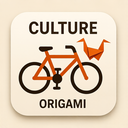
The icon described here is a masterful fusion of three profoundly symbolic elements—Culture, Bicycle, and Origami—each representing distinct yet interwoven aspects of human expression, progress, and creativity. This intricate design transcends mere visual appeal; it embodies a philosophy that celebrates the delicate balance between tradition and innovation, mobility and mindfulness, the tangible world and artistic imagination.
At its core, the icon features a stylized origami bicycle—an elegant representation where form follows function with an artistic flourish. The bicycle is not rendered in realistic detail but instead crafted as if folded from a single sheet of paper: sharp angles define its frame, and wheels are subtly shaped like circular kites or intricate fans, reminiscent of traditional Japanese paper art. The handlebars curl upward into delicate bird-like shapes, and the seat forms a perfect triangle with graceful symmetry. This origami transformation transforms the bicycle from an everyday mechanical object into a symbol of artistic interpretation—a vehicle not just for physical travel but for cultural journeying.
The choice of origami as the structural metaphor is deeply significant. Origami, originating in Japan over a thousand years ago, has long been more than just paper-folding; it is an art form steeped in philosophy. The precision and patience required to fold a single sheet into complex shapes reflect values of discipline, respect for material integrity, and the belief that beauty can emerge from simplicity. In this icon, the origami technique imbues the bicycle with a sense of sacred craftsmanship. Every fold is symbolic: it speaks to cultural preservation through handmade tradition and honors the quiet dignity found in creating something meaningful from minimal resources.
Culture is not merely an overlay but an intrinsic layer woven into every visual element. The color palette of the icon draws inspiration from traditional East Asian aesthetics—soft rice paper beiges, earthy browns, subtle indigo blues, and delicate cherry blossom pinks. These hues echo the natural materials used in origami and reflect a deep cultural respect for nature. Additionally, faint patterns inspired by Japanese shibori dyeing or Chinese batik designs subtly appear along the edges of the bicycle frame and within its folded components. These patterns are not decorative fluff; they serve as visual reminders of global cultural exchange—how traditions evolve through migration, collaboration, and adaptation.
Moreover, the bicycle itself is positioned at a symbolic intersection: it is neither fully modern nor entirely ancient. Its design evokes vintage bicycles from mid-20th century Japan or post-war Europe—a time when cycling became a symbol of democratic mobility and environmental consciousness. Yet its origami form distances it from industrial mass production, placing it in the realm of handmade culture and artisanal values. This duality speaks to a central theme: that modernity does not have to erase tradition. Instead, through thoughtful design and cultural awareness, new technologies can be imbued with timeless artistry.
The icon also incorporates subtle cultural narratives through its composition. The folded paper bicycle appears as if it is in mid-flight—hovering just above a path that winds like a traditional Japanese garden labyrinth or the winding alleys of an ancient Moroccan medina. This path suggests journey, not just physical movement but cultural evolution: how people, ideas, and values travel across borders through time. The inclusion of abstract elements such as folded paper birds in flight around the bicycle symbolizes freedom and communication—key aspects of cultural exchange.
Even the perspective contributes to its deeper meaning. Viewed from a slightly elevated angle, the icon mimics how origami unfolds from a single plane into three dimensions. This visual metaphor illustrates how culture is not static; it grows and expands through interaction, imagination, and reinterpretation—just as a flat sheet becomes an intricate sculpture through careful folding.
In essence, this icon serves as a universal emblem for sustainable living grounded in cultural respect. It suggests that innovation—like cycling—should be accessible, environmentally friendly, and rooted in human creativity. At the same time, it champions the idea that progress need not come at the cost of tradition; rather, tradition can inspire innovation when approached with reverence and imagination.
Ultimately, this icon stands as a visual manifesto: a reminder that our cultures are not fixed monuments but living structures—folded and refolded through time. Like an origami crane carrying prayers for peace, the bicycle of culture carries hope for a future where mobility is mindful, artistry is accessible, and every journey begins with the quiet act of folding one’s world into something new.
Create your own icon with our GoGPT AI prompt:
GoGPT