

Culture Book Origami Free icon download
Download all to grab every PNG variant.
```html
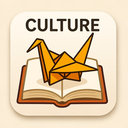
At the heart of this intricately designed icon lies a profound convergence of three timeless human expressions—Culture, Book, and Origami. Each element is not merely present as a visual motif but functions as a symbolic vessel carrying deep historical, intellectual, and artistic significance. The icon is envisioned as an elegant silhouette centered around an open book whose pages unfold like wings into the shape of a traditional origami crane. This fusion transcends mere aesthetics; it becomes a living metaphor for the interconnectedness of knowledge, tradition, and creative expression across civilizations.
The foundation of the icon is the book. It is rendered in rich, warm tones resembling aged parchment—its cover subtly textured to mimic vellum or handcrafted paper from ancient manuscripts. The book lies open at its center, its pages gently curling outward as if animated by a gentle breeze. These pages are not blank; they are inscribed with flowing calligraphy in multiple languages: Arabic script curves on the left, Devanagari scripts dance across the upper right, while Latin and Kanji characters appear on the lower edges. This multilingual integration emphasizes the universal nature of literature and intellectual exchange—an eternal thread that binds cultures through storytelling, philosophy, poetry, and wisdom. The book’s spine is adorned with a delicate inlaid pattern inspired by Persian miniature art and Japanese shibori dyeing techniques—symbolizing how cultural influences have long been interwoven across continents.
From the top corners of the open book emerge two wings crafted from folded paper, forming a majestic origami crane in mid-flight. This choice of the crane is deliberate: throughout East Asian cultures, particularly in Japan and Korea, the origami crane is a sacred symbol of peace, hope, longevity, and resilience. The act of folding 1000 cranes—known as *senbazuru*—is traditionally believed to grant wishes or heal the sick. By transforming the book’s pages into this symbolic bird, the icon suggests that knowledge itself can be an act of creation and healing—a creative process requiring patience, precision, and devotion. Each fold in the crane mirrors a step in learning: each page turned is both a revelation and an evolution of thought.
The transition from book to crane is seamless. The edges of the pages are carefully folded with meticulous attention to detail—each crease resembling traditional origami techniques such as the "inside reverse fold" and "squash fold." The final form of the crane is rendered in a soft, translucent white paper, almost luminous, suggesting purity and enlightenment. Yet beneath its surface lies a subtle gradient—shades of blue at the tail blending into gold at the head—evoking both sky and sun. This color symbolism reflects cultural values: blue signifies wisdom and calm (as seen in Buddhist iconography), while gold represents spiritual attainment and divine insight (a recurring theme in many ancient civilizations).
The background of the icon is a mandala-like design composed of interlocking patterns drawn from diverse cultural traditions. In the outer ring, motifs from Celtic knotwork intertwine with Andean textile designs and Islamic geometric tiling. At the center, where the book opens, lies a lotus flower—symbolizing spiritual purity and enlightenment in Hinduism and Buddhism—its petals subtly formed from inked sentences taken from world literature: lines from Rumi's poetry, excerpts from Confucius' Analects, fragments of Shakespearean sonnets, and verses by Matsuo Bashō. This fusion underscores the idea that culture is not static but a living tapestry continuously reshaped through dialogue across time and space.
What makes this icon truly remarkable is its dual nature: it functions simultaneously as a symbol of preservation and innovation. The book represents the preservation of cultural heritage—literature, history, art—that has been passed down through generations. The origami crane embodies human creativity—the act of transforming simple materials into something beautiful and meaningful—a practice that exists in every culture, from Japanese paper-folding to Native American dreamcatchers made from woven thread. Together, they suggest that culture thrives not only in conservation but also in reinvention.
Moreover, the icon speaks to the democratization of knowledge. In a world where access to books has expanded through digital media and open-access archives, this image reminds us that true learning is not confined by borders or language barriers. The crane—born from paper like a book—soars above these divisions, carrying with it messages of empathy, curiosity, and mutual respect.
In essence, the icon is more than a visual representation; it is an invitation—an artistic call to reflect on how culture nourishes us through stories (books), how creativity allows us to express and transcend our limits (origami), and how both are essential components of a shared human legacy. It stands as a timeless emblem: where knowledge takes flight, and tradition becomes art.
```Create your own icon with our GoGPT AI prompt:
GoGPT