

Culture Flower Digital glitch Free icon download
Download all to grab every PNG variant.
```html
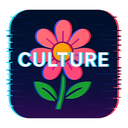
The icon in question is a striking visual synthesis that masterfully intertwines the themes of Culture, Flower, and Digital Glitch into a single, cohesive symbol. At first glance, it presents an ethereal blooming flower at its core—delicate petals unfolding in graceful arcs—yet beneath its natural elegance lies a subtle but pervasive distortion: the unmistakable signature of digital decay and disruption. This duality captures the essence of modern existence where ancient traditions coexist with technological evolution, both shaping and transforming one another.
The central flower is rendered with a high degree of botanical realism, evoking the cultural significance found in symbolic flora across civilizations. Its petals resemble those of a cherry blossom or lotus—a universal emblem in East Asian, Indian, and Middle Eastern cultures—each petal subtly patterned with intricate linework that mimics traditional embroidery or calligraphic strokes. These patterns are not merely decorative; they carry historical depth, referencing ancient motifs used in textiles, temple carvings, and ceremonial art. In some traditions, the lotus symbolizes enlightenment and spiritual purity; in others, the cherry blossom represents impermanence and the beauty of fleeting moments—a concept known as "mono no aware" in Japanese aesthetics. The flower thus becomes more than a visual element; it acts as a cultural vessel, encapsulating philosophies that have endured for centuries.
However, this serene botanical form is disrupted by an elegant yet jarring digital glitch effect that radiates from its center like ripples on water. The glitch appears not as a random distortion but as a carefully structured interference—pixelated fragments, color shifts, and fragmented edges that seem to flicker between states of clarity and chaos. These glitches are not crude errors; rather, they resemble the aesthetic of 'glitch art,' where digital artifacts are embraced as expressive elements. The lines of the petals subtly fracture at key junctures, revealing underlying binary patterns or distorted color gradients—shades of cyan, magenta, and electric blue bleeding into warm golds and deep violets. This interplay suggests a tension between organic growth and artificial manipulation: nature struggling to maintain its form amid digital contamination.
What makes this icon truly profound is how it redefines the relationship between Culture and Technology. The flower represents continuity—the timeless symbols, rituals, stories, and values passed down through generations. It is the living heritage of human societies: from indigenous dances to ancient poetry, from regional cuisines to sacred architecture. Yet the digital glitch reflects our contemporary reality—a world where culture is no longer confined to physical spaces or oral traditions. Today’s cultural expressions are frequently transmitted through social media, virtual platforms, and algorithmic curation. This shift brings both democratization and distortion: while access to global cultures has expanded exponentially, there is also a risk of oversimplification, appropriation, or erasure.
Thus, the glitch becomes symbolic not only of technological failure but of cultural transformation. It speaks to the idea that in our hyperconnected world, traditions are constantly being reinterpreted—sometimes lost in translation, sometimes reborn in unexpected forms. A traditional folk dance may be reimagined through motion-capture animation; a centuries-old myth may circulate as a viral meme; ancestral textiles might inspire digital fashion designs. The glitch represents this creative mutation—a beautiful yet disorienting evolution where the old and new coexist in dynamic tension.
Furthermore, the icon’s design employs subtle visual metaphors. The flower appears to be 'growing' from a circuit board pattern that forms its base—symbolizing how culture is increasingly embedded within digital infrastructure. Meanwhile, small fragments of ancient scripts or glyphs are scattered across the glitched areas—the Roman numerals subtly morphing into binary code; Sanskrit characters dissolving into pixelated noise. These details suggest that even as we digitize our heritage, its essence persists in fragmented forms—echoes of meaning buried beneath layers of technology.
Color plays a crucial role in reinforcing this narrative. The dominant palette blends earthy tones (soft greens, terracottas) with vibrant digital hues (neon cyan, electric magenta), creating a visual contrast that mirrors the collision between analog heritage and digital innovation. As the viewer’s eye moves across the icon, it experiences a journey: from calm and organic to chaotic and synthetic—mirroring how we navigate our own dual existence in physical and virtual realms.
In conclusion, this icon is not merely a visual symbol; it is a meditation on identity, continuity, and change. It celebrates the enduring beauty of cultural expressions embodied by the flower while acknowledging the disruptive power of digital evolution represented through glitch aesthetics. Far from being contradictory elements, Culture, Flower, and Digital Glitch are interwoven into a powerful metaphor: that true culture today is not static but fluid—rooted in tradition yet constantly redefining itself in response to the tools and technologies we wield. It is an icon for our time—a reminder that even as we lose some parts of the past to digital noise, new forms of meaning emerge from the cracks.
```Create your own icon with our GoGPT AI prompt:
GoGPT